
Several of the innovative, next-generation reactor designs are safer, smaller, modular, and more mobile. They may power space flights, run on recycled nuclear fuel, and even act as portable generators for disaster response. One design, molten salt reactors (MSRs), is gaining momentum in the nuclear community.
But, before any of these new reactor designs become reality, they need to undergo multiple rounds of safety and operational testing.
“Real-time monitoring is a valuable tool, particularly in the development of next-generation reactors. This can help designers more efficiently and effectively design and test flow loops, mechanisms, or processes,” said Amanda Lines, a chemist at Pacific Northwest National Laboratory (PNNL). “Also, when they ultimately deploy their reactor systems, this gives operators a tool to better understand and control those processes.”

A key off-gas byproduct from nuclear power generation is iodine, which is produced in several forms. In liquid-fuel molten salt reactors, iodine compounds would be monitored by taking samples at power plants and analyzing them in a remote laboratory. This method is slow and expensive — not to mention the added safety challenges and complexity of analyzing radioactive samples in a laboratory. Real-time monitoring involves no direct human interaction with the samples, and offers a less risky, more efficient alternative.
“It’s a real game-changer in terms of the steps you have to go through, and the timeline to sample iodine and other chemical species,” said Lines.
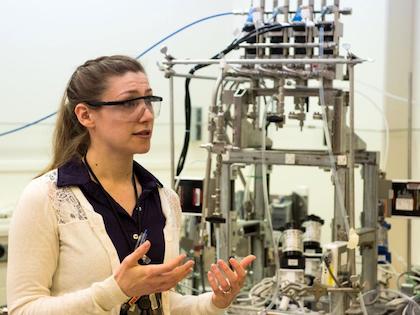
Amanda Lines, a PNNL chemist, develops real-time monitoring tools to pave the way for faster advanced reactor testing and design.
Source Andrea Starr, Pacific Northwest National Laboratory
Off-gas fission products are produced in all nuclear reactors. Iodine gas is a particular concern because it is radiotoxic, can easily vaporize and, if released, becomes airborne. The operation of molten salt reactors would require iodine be treated and scrubbed from the system as it is produced in real-time. This is not necessary in conventional light water reactors because the iodine is trapped in the fuel rods. To enable the real-time scrubbing, molten salt reactor plant operators will need continuous information about iodine levels.
The existing processes of tracking radioiodine levels are complex and expensive. This involves unpacking chemical behavior at the molecular level, since iodine can continually morph by binding with other elements, creating new molecules with different properties. This would be like baking a spice cake and then asking someone to figure out each ingredient.
The research team focused its sights on targeting two common forms of iodine — iodine monochloride and elemental iodine — and dialing in methods to quantify each. The goal was to search for the chemical “fingerprints” for each type of iodine produced using two common chemical analysis techniques — Raman spectroscopy and Fourier-transform infrared spectroscopy.
While the spectroscopy readings are useful to researchers, it was essential to convert that data into usable information for operators.
“We want an output that is easily understandable, especially for someone who hasn’t spent years of their life staring at spectrometry data,” Lines said.
The team also developed software that takes highly sensitive, spectroscopic light readings from existing, off-the-shelf technology and transforms that data into real-time, usable information for plant operators. Next up, the team plans to take what they have learned from these studies and expand it to other byproduct gases.
“Ultimately these are tools that can help expand research and development efforts, particularly in terms of next-generation reactor design and testing,” said Sam Bryan, a PNNL laboratory fellow and chemist. “Real-time monitoring can enable new types of reactors by solving problems on the front end.”