
The new way of life resulted in organizations adjusting their corporate networks and led to the emergence of new threats to target those networks, as well as the strengthening of existing threats, said Kaspersky researchers in their latest report entitled “Story of the year: remote work.”
There was a 242 percent growth of brute force attacks on remote desktop protocol (RDP) compared to last year and 1.7 million unique malicious files disguised as apps for corporate communication, researchers found. Both of these findings reflect the ways attackers set their sights on users that work from home.
Sending employees to work from home in such a short timespan opened up new vulnerabilities that cybercriminals were quick to target. The volume of corporate traffic grew, and users swiftly moved to using third-party services to exchange data, often working via potentially insecure Wi-Fi networks.
Headaches Galore
Another headache for information security teams was, and still is, the increased number of people using remote-access tools. One of the most popular application-level protocols for accessing Windows workstations or servers is Microsoft’s proprietary protocol, RDP. Computers that have been made available to remote workers and were incorrectly configured grew in number during the first wave of lockdowns across the globe, and so did the number of cyberattacks on them. These attacks usually attempted to brute-force (systematically trying to find the correct option) a username and password for RDP. A successful attempt resulted in cybercriminals gaining remote access to the target computer in the network.

Since the beginning of March, the number of Bruteforce.Generic.RDP detections skyrocketed, resulting in the number detected in the first eleven months of 2020 growing by 3.4 times, compared to the number of the same type of attacks in 2019. Overall, 3.3 billion attacks on Remote Desktop Protocol ended up detected between January and November 2020. In 2019, during the same 11-month period, Kaspersky detected 969 million of these attacks worldwide.
Aside from attacks on RDP, cybercriminals were quick to figure out workers replaced offline communication with online tools and so they decided to abuse this demand too. Kaspersky detected 1.66 million unique malicious files spread under the guise of popular messenger and online conference applications, typically used for work. Once installed, these files would primarily load Adware programs that flooded victims’ devices with unwanted advertising and gathered their personal data for third-party use. Another group of files disguised as corporate apps were Downloaders. These are applications that may not be malicious on their own, but are able to download other harmful apps, from Trojans to remote access tools.
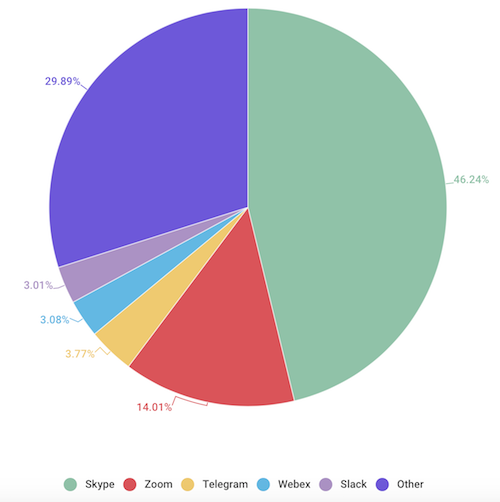
Applications used as lures, January – November 2020Source: Kaspersky
“This year taught us a lot,” said Dmitry Galov, security researcher at Kaspersky. “The move online was not as flawless as one would imagine, especially given that we already lived in what we thought was a digitized world. As the focus switched to remote work, so did the cybercriminals, who directed their efforts to capitalize on a rise in adoption. I am happy to state that the adoption process was fast and this meant the world could go on. Economies did not freeze and we still get to have our coffee, albeit, via delivery services. Yet now we know that there is still a lot to learn about the responsible use of technology, with data sharing at the heart of it.
Online Dangers
“One of the biggest challenges of 2020 turned out to be awareness of potential online dangers,” Galov said. “The key here is not that the sudden demand for online services – be they work-related or for food delivery – grew. Many new users were people who in principle avoided being so digitally exposed in first place. They did not necessarily disregard the need for cybersecurity – they had simply chosen not to use digital services before and were less educated about what can happen online. This group of people turned out to be one of the most vulnerable during the pandemic – their level of awareness of online dangers was very low. It seems like we have been given a big challenge worldwide and I hope that helped increase the level of cybersecurity awareness among ordinary users.”
Since working from home is here to stay, Kaspersky recommends employers and businesses follow the advice below to stay on top of any potential IT security issues when their employees work remotely:
- Enable access to your network through a corporate VPN and, if possible, enable multi-factor authentication to stay protected from RDP attacks.
- Use a corporate security solution empowered with network threat protection.
- Ensure your employees have all they need to securely work from home and know who to contact if they face an IT or security issue.
- Schedule basic security awareness training for your employees. This can occur online and cover essential practices, such as account and password management, endpoint security and web browsing.
- Ensure devices, software, applications and services are kept updated.
- Ensure you have access to the latest threat intelligence to bolster your protection solution.
- In addition to physical endpoints, it is important to protect cloud workloads and virtual desktop infrastructure.
Click here for more information on the report.