
By Gregory Hale
As the manufacturing automation sector embraces increased connectivity and a more digital workplace, it has become clear defenders need more network visibility because attackers are very opportunistic and will take advantage of any weakness – and there are plenty.
Yes, the advantages of this increased connectivity far outweigh the risks, but make no mistake about it, there are risks. But for a business to advance and keep growing its profitability, manufacturers need to take security seriously and bake it into the very essence of the organization.
State of Cybersecurity
That backs up a report Claroty conducted entitled, “The Global State of Industrial Cybersecurity 2021: Resilience Amid Disruption,” an independent, global survey of 1,100 information technology (IT) and operational technology (OT) security professionals who work full time for enterprises that own, operate, or otherwise support components of critical infrastructure.

In the report one question asked was has the speed of your organization’s digital transformation accelerated since the start of the COVID-19 pandemic? From a global perspective 51.64 percent said yes, while only 9.82 percent said no. On the other hand, 38.55 percent said yes, it has somewhat accelerated, but more could be done.
Antova said with that growth there are challenges, but they are not overwhelming.
“What makes it more challenging these days, is we have more distributed everything,” she said. “Not only are humans more distributed, but there is more connectivity between systems, reporting systems, data analytics that need to communicate between each other to reap the benefits of all that productivity. Obviously, with multiple connectivity points you have more exposure. Now, the cybersecurity protocols and products and the way cybersecurity is baked in many of the digital transformation activities, it also makes it easier to deploy them today than it was 10 years ago.”
Survey respondents said digital transformation has accelerated since the start of the COVID-19 pandemic and, on a global basis, some level of remote work will continue at 73 percent of organizations for the foreseeable future.
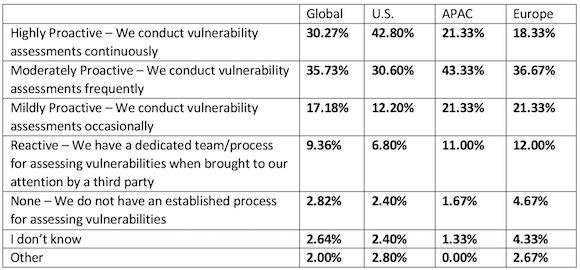
Which of these best describes your vulnerability management strategy?
Source: Claroty
With the continuation of remote work, that will place more stress to ensure a protected network, but the survey found respondents were confident in their level of security.
Confident in Security
Most respondents categorize their organization’s cybersecurity maturity at level 4 out of 5, the managed level, with Europe the exception at maturity level 3 out of 5. And on a global basis more than 65 percent rate their vulnerability management strategy as moderately to highly proactive, with Europe at 55 percent. Yet ransomware attacks are still highly successful.
In the end, it means there is more reliance on technology, but there needs to be a plan in place to cover all bases much like what happened in Ukraine a few years back when attackers shut down the grid and workers had to go to a manual operation to fire the grid back up.
“We are very much dependent on technology and that is not a bad thing,” Antova said. “That comes with a couple implications. The first is we have to think through very carefully before having a plan on how to switch to manual. Even before that, though, you need to have technical compensating controls in place, so you try to avoid the situation to begin with. That is where cybersecurity comes into play. If cybersecurity fails, how can you contain the impact, so the entire network is not affected.”
In one example, Antova equated the network attack to the healthcare industry.
“We have seen healthcare devices that can save your life on the same network as everything else. In the vast majority of cases there is no segmentation. Come on, this is 2022 this should not be the case. You should have segmentation between the important things in your network and the not too important things.
“Companies need to have disaster recovery plans,” she said. “We are living in an extremely interconnected world and we are getting the benefits of the technology. We just need to think about how to protect all the good benefits we are getting. Then we have to do a decent job in protecting them.”