
The energy company that owns the ruptured pipeline that spewed more than 140,000 gallons of oil into Southern California waters didn’t shutdown the pipeline for more than three hours after being alerted, according to federal regulators.
In a letter to Amplify Energy Corp.’s president, U.S. Department of Transportation safety regulators wrote company personnel “received a low-pressure alarm” at 2:30 a.m. Saturday on the pipeline that signaled “possible failure.” It wasn’t until 6 a.m. – more than three hours later – it was shutdown, the letter said.
Facts in Letter
The letter was sent to the pipeline operator’s parent company, Amplify Energy Corp., from the department’s Pipeline and Hazardous Materials Safety Administration (PHMSA), oversees the pipelines across the country. The letter also notes it took “over six hours” before the company reported the spill to the 24-hour federal National Response Center, the designated federal point of contact for reporting all oil, chemical, radiological, biological and etiological discharges into the environment.

When a single drop of oil spills in the ocean off the U.S. coast, it must, by law, be immediately reported to the center.
In a new development, the U.S. Coast Guard determined a possible cause of the spill: A cargo ship’s anchor may have hooked the pipeline, dragging it more than 100 feet and causing the foot-long gash.
The U.S. Coast Guard said Tuesday divers were able to locate a bend in the 17-mile pipeline and found it had been moved by 105 feet. Coast Guard Capt. Rebecca Ore said divers also located a split in the pipeline that was 13 inches long, which investigators believe could be the source of the oil leak.
Anchor Hooks Pipeline
Preliminary reports said the failure may have been “caused by an anchor that hooked the pipeline, causing a partial tear,” federal transportation investigators said.
The break in the line occurred about 5 miles offshore at a depth of about 98 feet beneath the surface, the investigators said. Those findings were included in an order from the Department of Transportation that blocks the company that operates the pipeline from restarting it without extensive inspections and testing.
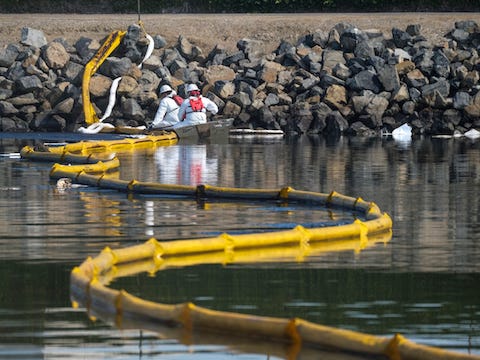
Crews deploy skimmers and booms in an effort to stop further incursion into the Wetlands Talbert Marsh in Huntington Beach, CA, after one of the largest oil spills in recent Southern California history fouled beaches.
Source: AP
A ship’s anchor striking a pipeline on the ocean floor is “one of the distinct possibilities” behind the leak, Amplify Energy Chief Executive Martyn Willsher said.
Dozens of ships have been anchored offshore in recent months because ports are suffering from backlogs as COVID-19 and other issues slowed the global supply chain.
“We’re looking into if it could have been an anchor from a ship, but that’s in the assessment phase right now,” Coast Guard Lt. Cmdr. Jeannie Shaye said.
On Monday, about two dozen large cargo ships could be seen from the shores of Huntington Beach anchored along the coast. Investigators are examining whether a ship’s anchor may have struck the pipeline, causing more than 140,000 gallons of oil to spill into the ocean.
About two weeks ago, the backlog of cargo ships off the coast of the Huntington Beach area were waiting to dock at the ports of Long Beach and Los Angeles broke records. 73 container ships were floating in the waters on Sept. 19 waiting to dock at the ports, according to the Marine Exchange of Southern California.
Monitor for Leaks
The pipeline was supposed to be monitored by an automated leak detection system and control room staffed 24 hours a day, seven days a week. The system, part of Amplify’s spill response plan, was designed to trigger an alarm whenever a change in the flow of oil is detected. How fast it can pick up on those changes can vary according to the size of the leak.
When 10 percent or more of the amount of oil flowing through the pipeline is leaking, the detection time is about five minutes. Smaller leaks take up to 50 minutes to detect, according to the plan.
Along with pinpointing the cause of the leak, the criminal and civil investigations will try to determine why it took so long for Amplify to learn of and report the unfolding disaster.
The first emergency call came in Friday at 6:13 p.m., and it wasn’t from Amplify. A ship had noticed a sheen in the water, according to a federal report on the California Governor’s Office of Emergency Services spill report website.
Officials at the National Oceanic and Atmospheric Administration notified the federal response center twice that night of a possible oil spill less than 5 miles off Huntington Beach, according to updates on the California emergency services website.
The Coast Guard addressed questions about the timeline Tuesday and said it did not investigate the initial reports of the oil spill for nearly 12 hours because it didn’t have enough corroborating evidence and was hindered by darkness and a lack of technology.