
The blast occurred at the CSX Curtis Bay Coal Terminal just after 11:30 a.m. Thursday, in the southernmost part of the city off the Patapsco River, said Cindy Schild, a spokesperson for railroad freight corporation CSX.
The explosion occurred in a five-story silo at the site on Benhill Ave. and Baltimore Fire’s HazMat, Special Rescue Units & Fireboats all responded to the scene, said officials at Baltimore Firefighters IAFF Local 734. All employees were accounted for and no one suffered an injury.
The explosion was so strong it set off car alarms and even shattered windows three to four miles away.

“Once units arrived on the scene, we were advised contractors were working to move coal on a conveyer belt when the coal dust explosion occurred,” said Baltimore City Fire spokeswoman Blair Adams.
Coal dust is listed among the combustible dusts from the Occupational Safety and Health Administration says are fine particles that present an explosion hazard when suspended in air under certain conditions.
“To our knowledge, the structural damage has been contained and is internal,” said Baltimore City Councilwoman Phylicia Porter.
The fire department tested for gas and confirmed none was detected at the site, and also requested an on-site air quality test from the Maryland Department of the Environment.
“CSX appreciates the swift response of the Baltimore Fire Department,” Schild said. “The cause of the incident is under investigation.”
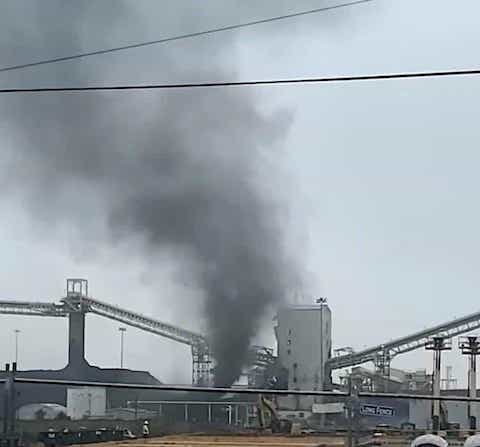
Smoke billows after an explosion that rocked the Baltimore, MD, CSX Curtis Bay Coal Terminal off the Patapsco River Thursday.
Source: Baltimore Firefighters IAFF Local 734
The particulate size of the coal must be very small to allow it to suspend in the atmosphere. Eventually, it settles out on any flat surface where it can build up to amounts that can form an “explosive” concentration.
If something disturbs the dust, it then creates a dust cloud with a high enough concentration. It’s usually as series of events that cause it.
First, something small happens and disturbs some dust, like a conveyor bearing overheating and causing a belt to tear, dislodging fine dust which is ignited by the hot bearing.
Second, more dust is disturbed by the first ignition, and this is much more severe, dislodging all the dust in the area
Third, after two prior ignitions, there’s plenty of ignition sources to be found, forming the last and most severe blast. Luckily, coal dust doesn’t develop aa high a peak pressure as other dusts, Group E, F, & G defined in the NEC, NFPA 70, Chapter 5.
Engineering Controls and/or Housekeeping is the only way to prevent it. There was no mention of that in the report.