
When it comes to security, it only makes sense to have a leader that understands the objectives of the company and then apply the proper people, processes and technology to ensure an effective and productive environment.
That all sounds fine in a perfect world, but we all know this is not a perfect world. So, with that in mind, manufacturers need to understand how to become more productive and more profitable, while remaining secure.
That is where the cyber champion comes into play. “Historically, security is the party of no. You can’t do this, and you can’t do that,” said Ryan LaSalle, senior managing director for Accenture Security. “Business blockers are endemic of that characterization. They try to hold the line and enforce security policies.”
“Over the last couple of years, there has been a real push to have the CISO be at the table with the business leaders and part of it is to understand how the business is run. Many of them have become ‘yes’ folks, saying if you want to accept the risk, then let’s go and we will figure it out. They are the cyber risk takers. However, there has been a rise of the executive that can balance both. They can be the technician that understands the threat and they can be the busines leader who is at the table and advising and understanding how the business runs. The executive that can do both is the cyber champion. They are a minority of our community. Our sampling is 170 companies had cyber champions out of the 4,700 we talked to.”

Other Survey Facts
Also, in the survey, 55 percent of large companies are not effectively stopping cyberattacks, finding and fixing breaches quickly, or reducing the impact of breaches.
In addition, four in five respondents (81 percent) believe “staying ahead of attackers is a constant battle and the cost is unsustainable.” That is a hike from 69 percent in last year’s survey. At the same time, while 82 percent of survey respondents increased their cybersecurity spending this past year, the number of successful breaches — which include unauthorized access to data, applications, services, networks or devices — jumped 31 percent over the previous year, to 270 per company, on average.
While the survey did say security is getting more budget, it doesn’t necessarily mean they are spending the money correctly. Oftentimes, they need to understand what they have and build up from the bottom.
“Organizations are doing the basics fundamentally wrong,” LaSalle said. “When you can’t do those things right, it is not the nation states you have to worry about. If you track the progression of ransomware, it has gotten more professionalized, more intelligent, more focused and they evolved the pain points to the business executive to where they cry uncle.”
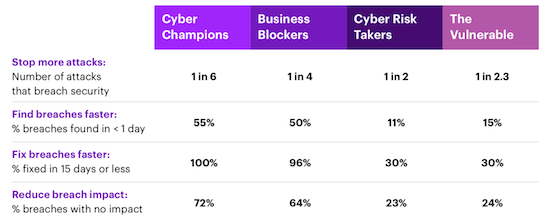
Key measures of cyber resilience.
Source: Accenture
Focus on Fundamentals
While more companies need to focus on the fundamentals, LaSalle said, “getting the basics right isn’t always easy, it is more complex than you would think.”
With companies facing on average 270 attacks per company per year, that boils down to one attack every 1.3 days.
That may seem daunting, but LaSalle said, again going back to basics, there are three steps to follow:
- Be prepared and know who is coming after you.
- There are a bunch of capabilities you need to have in your environment, in your defenses, in your technology and your business, your people are a target, your technology is a target, and your data is a target. You need to use a lot of automation. You can’t scale your defenses as fast as the attackers can scale their attacks. Automation can help.
- You have to have friends. You need to have friends in law enforcement, technology partners. You need to rely on the kindness of your friends.
“If you work with those three pieces you will have success,” he said.
When it comes to security, the more cyber and business savvy a CISO is, the more effective the company will be to fight off all types of attack challenges. A cyber champion can lead the way.
Champion Commitment
“There is a commitment to make it work for you to align where the business risks are. In the end, though, being a cyber champion will be more cost effective compared to a successful attack.”
“You have got to use your imagination to keep upping your game in defense,” LaSalle said.
Click here to download the report.