
Madison Height City Council approved a contract for The Adams Group to begin razing the Electro-Plating Services site at 945 E. 10 Mile Rd. on Thursday.
The demolition is expected to cost $750,000. To finance the effort, the city received $600,000 from state lawmakers and $150,000 from Oakland County.
Before the demolition could even take place, the Environmental Protection Agency spent more than $3.1 million to clean up the site and prepare it.

State Sen. Jeremy Moss, D-Southfield, said the incident is a reminder of the importance of holding polluters accountable and protecting the public.
“Madison Heights endured the saga at Electro-Plating Services for far too long and this demolition will provide overdue closure for our community,” Moss said. “This entire incident should compel all of us to be better stewards of our environment and I’ll continue this work in the State Senate to ensure polluters are held accountable.”
Electro-Plating Services was shut down by state regulators in 2016 due to mismanagement of industrial waste, after nearly 50 years of operation.
The owner of the factory, Gary Alfred Sayers, got a year in prison in November 2019 for illegally storing hazardous materials at the site. Some of the hazardous materials were stored in a dirt hole in the basement, where the chemicals seeped into the ground and eventually found a path onto the freeway.
The green slime was groundwater contaminated with cancer-causing hexavalent chromium.
“Illegal storing of hazardous waste is a danger not only to the environment, but to communities as well,” said U.S. Attorney Matthew Schneider after Sayers pleaded guilty. “The actions by this defendant showed a blatant disregard for the law. It is our hope that prosecutions such as this one will serve as a deterrent to others who seek to serve their own interests rather than the safety of the environment.”
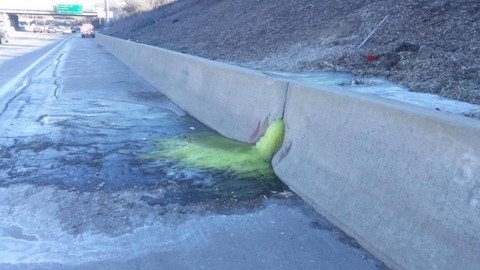
Green liquid oozes from a retaining wall along I-696.
Source: Michigan Department of Transportation
Electro-Plating Services was located at 945 E. 10 Mile Road in Madison Heights. The Michigan Department of Environmental Quality (MDEQ) first issued the cease-and-desist order in December 2016.
Tracy Kecskemeti, MDEQ district supervisor for southeast Michigan, said the move against the company was highly unusual for the MDEQ.
“We declared an imminent substantial hazard — something we have done only one other time (with an operating business) in the 30-some-year history of our hazardous wastes program,” Kecskemeti previously said. “It’s incredibly uncommon this would happen with an operating business. It’s one thing if it’s an abandoned building — that’s more common, at least occurring every year — but to do this with an operating business is rare. Here, the traditional means for gaining compliance would not work with the owner. We had to get creative and ask what the law allows us in this circumstance.”