
With a vast majority of people staying home and working, there have several threats abusing tools utilized in work from home (WFH) setups, a researcher said.
Cybercriminals are using credential phishing sites to trick users into entering their credentials into fake login pages of email and collaboration platforms and videoconferencing apps, according to analysis by Trend Micro analyst Paul Christian Pajares. Although these threats are not new, the need for better solutions is heightened due to the current experience and landscape.
Over the years, cybercriminals have remained active in propagating credential phishing campaigns.
There was a 35 percent increase in the number of credential phishing attempts involving unknown phishing links from 2018 to 2019, according to the Trend Micro 2019 Cloud App Security Report. This may mean threat actors continuously produce new phishing links to evade detection by security software, Pajares said. On top of that credential phishing attacks detected and blocked by Trend Micro Cloud App Security also increased by 59 percent from 1.5 million in the second half of 2018 to 2.4 million in the first half of 2019.

Along those lines, researchers analyzed tools companies use for WFH arrangements: Outlook on the web (formerly known as Outlook Web Access) and other Office 365 applications such as SharePoint, and videoconferencing apps WebEx and Zoom.
Credential phishing using Outlook on the web and Office 365 as bait has hit users in several countries. Data from our Smart Protection Network indicates over 50,000 phishing detections from January 2020 to April 27 of the same year, with the threats affecting users in the United States, Germany, Canada, Taiwan, Japan, Australia, Hong Kong, and other countries.
Employees commonly use Outlook mailbox in the office but some use the Outlook for the web version when accessing email outside the office. If not careful, they may mistakenly attempt to log in to a phishing page designed to look like Outlook’s login page.
Many employees are accessing files and collaborating online through Office 365. Sites associated with this are also spoofed and used as phishing campaign lures.
Attackers are also using phishing campaigns that use videoconferencing apps such as WebEx and Zoom as bait.
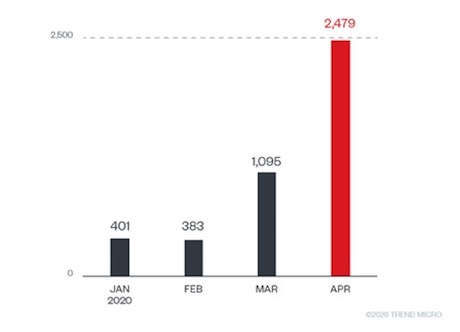
Threat detections for Zoom and WebEx from January to April 2020.
Source: Trend Micro
There were almost 2500 threat detections for Zoom and WebEx from January to April 2020.
WFH setups rely on videoconferencing apps for better communication. Cybercriminals take advantage of this by attempting to harvest credentials through phishing pages. Other threats using these apps as bait include malicious domains and fake apps.
Threat actors either compromise legitimate sites or create malicious domains to host phishing pages. We traced the IP hosting locations of the sources of these domains and found the United States has the highest unique IP count, with 833. Trailing far behind is the Netherlands at 78 and Germany at 44.
One of the ways threat actors spread credential phishing pages is through email. Below are some of the best practices for defending against this threat:
- Never click links in emails coming from untrustworthy sources.
- Examine URLs embedded in emails by hovering the mouse pointer over it. This may reveal it leads to another URL.
- Check for grammatical errors and spelling mistakes, which are common indicators the email did not come from reputable companies.
- Even if a page looks like a legitimate login page, inspect the URL to confirm its legitimacy.
- Avoid sharing sensitive personal information online.