
The new development actually lies in its simplicity, applicability, and durability, said Professor Seungbum Hong of the Korea Advanced Institute of Science and Technology (KAIST). Wearable devices are increasingly seeing greater use in a wide array of applications from small electronics to embedded devices such as sensors, actuators, displays, and energy harvesters.
Despite their many advantages, high costs and complex fabrication processes remained challenges for reaching commercialization. In addition, their durability was frequently questioned. To address these issues, Hong’s team developed a new fabrication process and analysis technology for testing the mechanical properties of affordable wearable devices.
The newly developed fabrication process will enable the direct application of a device into general garments using hot pressing just as graphic patches can be attached to garments using a heat press.

In particular, when the polymer film is hot pressed onto a fabric below its crystallization temperature, it transforms into an amorphous state. In this state, it compactly attaches to the concave surface of the fabric and infiltrates the gaps between the transverse wefts and longitudinal warps. These features result in high interfacial adhesion strength. For this reason, hot pressing has the potential to reduce the cost of fabrication through the direct application of fabric-based wearable devices to common garments.
In addition to the conventional durability test of bending cycles, the newly introduced surface and interfacial cutting analysis system proved the high mechanical durability of the fabric-based wearable device by measuring the high interfacial adhesion strength between the fabric and the polymer film. Hong said the study lays a new foundation for the manufacturing process and analysis of wearable devices using fabrics and polymers.
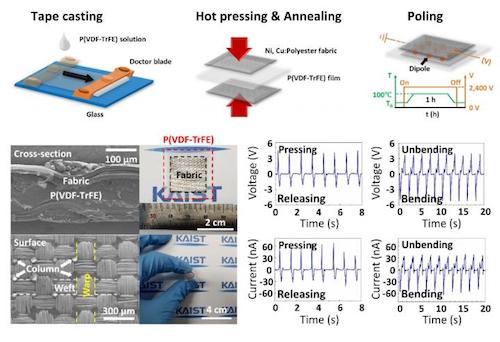
Fabrication process, structures, and output signals of a fabric-based wearable energy harvester.
Source: KAIST
“This study could enable the commercialization of highly durable wearable devices based on the analysis of their interfacial adhesion strength,” Hong said. “Our study lays a new foundation for the manufacturing process and analysis of other devices using fabrics and polymers. We look forward to fabric-based wearable electronics hitting the market very soon.”
The results of this study ended up registered as a domestic patent in Korea last year.