
The incident occurred August. 21, 2020, when a rupture caused a huge fireball that enveloped and destroyed the dredge Waymon L. Boyd, operated by Orion Marine Group. Four crewmembers died immediately, another died later of injuries, and five more suffered serious injuries. The Waymon L. Boyd, valued at $9.48 million, was a total loss. Damage to the pipeline was $2.09 million, and damage to the Epic oil terminal was $120,000.
As a result of the investigation, which the National Transportation and Safety Board (NTSB) accepted at its December 7 meeting, the board issued 10 recommendations: Three to the Pipeline and Hazardous Materials Safety Administration, one to Coastal and Marine Operators, two to Coastal and Marine Operators and the Council for Dredging and Marine Construction Safety, three to Orion Group Holdings and one to Enterprise Products.
“We have seen time and time again that tragedies happen when parties fail to have the appropriate policies and procedures in place for safety,” NTSB Chair Jennifer Homendy said during the meeting. “Orion Marine Group’s inadequate planning led to this tragic event and cost lives. It is absolutely critical that when excavators conduct any dredging operations near underwater pipelines that proper precautions are in place to ensure safety.”
Safety Zone
The incident occurred around 8 a.m. in the upper reaches of the Corpus Christi Ship Channel in the Tule Lake Channel. Initially, the U.S. Coast Guard closed the port’s inner harbor inward from the Harbor Bridge. Later, as incident responders began recovery and salvage efforts, the Coast Guard established a safety zone between the Chemical Turning Basin and Viola Turning Basin.

Coast Guard Air Station Corpus Christi immediately launched an MH-65 Dolphin helicopter to the area. Two injured crewmembers of the Waymon L. Boyd were hoisted aboard and transported to a nearby hospital. Also responding to the initial fire and recovery mission were two 45-foot response boats from Coast Guard Station Port Aransas; crews from Coast Guard cutters Chinook, Sturgeon and Manta; the Port of Corpus Christi police and fire departments; Signet Maritime tugs; the U.S. Army Corps of Engineers; the Texas Commission on Environmental Quality; and the Texas General Land Office.
Emergency responders battled the fire aboard the Waymon L Boyd throughout the day August 21, with search and rescue efforts ongoing. The fire was finally fully extinguished around 10 p.m., when the vessel broke in two and sank. In the early morning hours of August 22, the body of one of the missing crew members was recovered. Emergency responders found the body of a second missing crew member about 10:45 a.m. that day.
Diesel Fuel Removed
The Texas General Land Office, which led the oil spill response, reported about 1,600 gallons of diesel fuel removed from the water, along with 680 gallons of a diesel fuel/water mix.
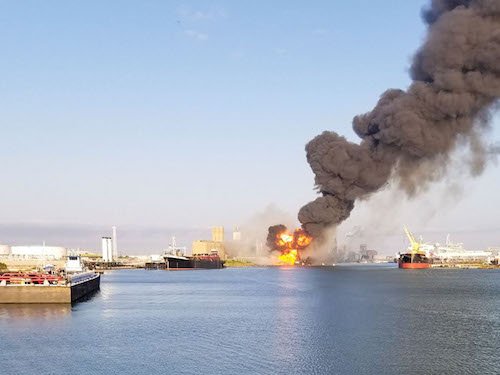
A fire erupted when a pipeline ended up ruptured that enveloped and destroyed the dredge Waymon L. Boyd on August 21, 2020. Five workers died and six others suffered serious injuries.Source: U.S. Coast Guard
The incident was partially captured on a terminal camera, whose footage was shown at the NTSB board meeting. The dredge is just offscreen, to the right of the screen. The camera shakes when the initial pipeline breach happens; a couple of minutes later, the fireball erupts into the screen from the right.
Among the teams’ findings:
- Orion had no written procedures and policies for planning operations near pipelines specifically. Its safety meeting included general information about weather, personal protective equipment and other matters not specific to the site itself. It had no evacuation procedures in case of a pipeline emergency, which could have resulted in quicker reactions.
- The engineering plans the terminal operator, Epic, submitted did not accurately show the proximity of the pipeline to the dredging area. These inaccurate plans were uploaded into dredging software the operator who guided the cutterhead, called a leverman, relied on.
Orion didn’t have written procedures or policies for uploading information into the software, called Dredgepack. - Correct information about the slope from the bank to the dredged area, which included the pipelines, wasn’t shaded or marked on the charts given to the Orion teams. Instead, the Dredgepack software calculated and generated its own slope using an algorithm.
- Once the information had been uploaded into Dredgepack, it was assumed to be correct. The leverman, who actually operated the cutterhead without being able to directly see it, testified he believed the cutterhead was “not outside the template.” In fact, it was operating within 1 foot of the pipeline, when the margin of error for cutterhead placement was 3.3 feet. The leverman guided the cutterhead according to a screen display in which the cutterhead was represented by a large “X,” and feet were reduced to pixels.
- The pipeline’s operator, Enterprise, had performed a pipeline survey in 2018 that accurately identified the pipeline location. Another survey performed after the incident was found to match the 2018 survey’s pipeline location “within inches.” But the 2018 survey that was made available to the Orion team didn’t include tolerance zones or “no-go” areas.
- Although Orion included Epic in its planning meetings, it didn’t include anyone from Enterprise.
- Orion’s safety planning didn’t include immediate responses in case of a pipeline rupture, which include securing or shutting off all ignition sources. The Waymon L. Boyd investigation concluded that after the initial rupture, an aerosol of mixed propane gas and water engulfed the vessel and was drawn via vents into the engine room, where it encountered an ignition source.
- Texas regulations governing distances and tolerance zones to pipelines were drawn up with land-based pipelines in mind and may not be fit for purpose in marine construction projects.
- Because the pipelines were deemed to be outside the dredging area, they were not marked with required markings, which would have included buoys and been placed every 20 feet. Instead, an Orion team member informally requested courtesy markings because he was concerned about anchor placement, not dredging. The courtesy markings, which were not required, consisted of cane poles and were only placed every 200 feet, were less visible, and in any case were not designed to guide dredge operators in avoiding pipelines.
NTSB Conclusions
NTSB concluded marine dredging projects require a greater level of collaboration and review between pipeline operators and dredging companies than the one-call process provides because of the challenges associated with marking marine pipelines and the lack of precision associated with dredging operations, according to the report.
In addition, third-party damage prevention efforts would be improved if dredging companies obtained accurate location data from pipeline operators for pipelines within and near dredging project boundaries to incorporate into dredge control software files.
Click here for the executive summary, probable cause, findings and safety recommendations.