
Yes, for some critical tasks they will be mind-bogglingly faster and use much less electricity than today’s computers. However, and here’s the bad news for those looking for a secure environment, these computers will be able to crack most of the encryption codes currently used to protect our data, leaving our bank and security information vulnerable.
Currently, most security relies on mathematical manipulations that, at present, ensure a very high level of security – it would take a regular computer billions of years to break one of those codes.
One approach is to use the quantum properties of single photons (particles of light) to securely encrypt a message so any attempt to hack it is immediately detectable by the sender and recipient. However, getting a suitable source of single photons has been an immense challenge.

Now, however, a team of researchers, led by Professor Ronen Rapaport and Dr. Hamza Abudayyeh of the Racah Institute of Physics at the Hebrew University of Jerusalem (HU), together with Professor Monika Fleischer, Annika Mildner and others at the University of Tübingen in Germany, achieved a breakthrough. Their findings bring the world closer to a simple and efficient method of quantum encryption.
Banks and government departments are already investing heavily in quantum encryption that relies on laser beams. However, laser beams often release several photons at once or none at all. What is needed for optimum security is a source that can emit a fast but steady stream of single photons – in one direction and at room temperature.
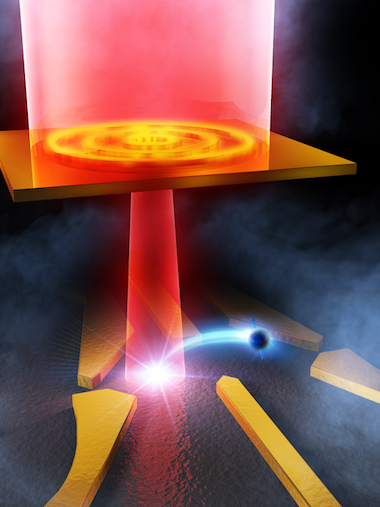
A single photon could securely encrypt a message so any attempt to hack it is immediately detectable by the sender and recipient.
Source: Lars Luder
The team at HU developed a system that uses fluorescent crystals in the form of specks so tiny that special microscopes are needed to see them. Known as quantum dots, each dot measures much less than a thousandth of the width of a human hair. A laser beam shone at the quantum dot causes it to fluoresce and emit a stream of single photons.
These quantum dots are individually mounted on golden pinheads – except, of course, it is a nano-pinhead, or nanocone, almost a hundred thousandth the size of a regular pinhead. Nanocone are able to increase the quantum dot emission of photons 20-fold. This stream of photons is then shot off in a single direction by a “Bragg grating” acting as a type of antenna.
The HU-Tübingen device is not only useful for quantum encryption, but in other situations that rely on quantum bits to encode information, such as quantum computation.
“At present, we have a good prototype that has the potential for commercialization in the near future,” Rapaport said.
The advantage of quantum cryptography lies in its physical determinism.
“Laws of science cannot be broken – a single photon cannot be split, no matter how hard one tries. Mathematical complexities might be very difficult to solve, however they are vulnerable to attack and breaches unlike quantum-based security systems,” Abudayyeh said.
The team is currently improving their device so it can provide an even more reliable and efficient stream of single photons that could be used in a wide range of quantum technologies.