
The problem is new security professionals rarely learn practical skills for protecting these targets until they are on the job at nuclear power plants, research reactors, processing plants and other nuclear facilities.
“There is a need to have students who are technically trained in nuclear security before they work at a laboratory, a government agency, or at a commercial nuclear facility,” said Alan Evans, a Sandia National Laboratories nuclear engineer.
Their goal: create a one-of-a-kind, graduate-level program — one that has access to two national laboratories — that focuses on technical skills in education, research and professional development.

This program has financial backing from the National Nuclear Security Administration’s Office of International National Security and has been bolstered by a memorandum of understanding signed in September between Sandia and UNM that outlines the program’s development over the next five years.
The hope with the new agreement is to create more robust opportunities for current and future nuclear engineering students at UNM, said Hyoung K. Lee, professor and chair of the UNM Department of Nuclear Engineering.
“UNM has such a phenomenal resource right in its backyard with Sandia, so it makes sense to maximize that proximity by creating a partnership that will truly enhance students’ education,” he said. “We are very excited to be developing this program that we feel, with Sandia’s collaboration, will offer UNM students an incredible advantage in the nuclear security field.”
At the core of the team’s vision is a shift toward engineering.
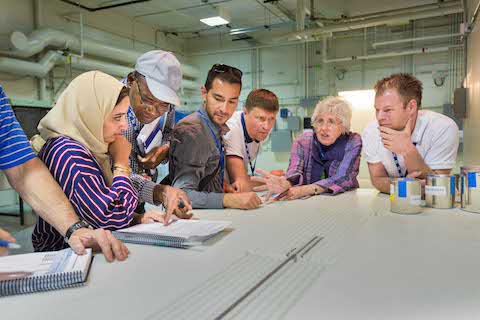
Attendees at Sandia National Laboratories’ 2018 International Training Course practiced accounting for nuclear materials. Sandia is building a new graduate-level program with the University of New Mexico to extend similar resources to students and working professionals.
Source: Randy Montoya, Sandia National Laboratories
“There are other university programs in nonproliferation and nuclear security — some of which Sandia already works with — but a lot of these classes focus on policy and concepts,” Evans said. “So, we had to ask ourselves: How can we better prepare the next generation of experts to apply traditional engineering capabilities to nontraditional challenges facing nuclear security for tomorrow?”
The answer lies in forming the right team, said Adam Williams, a Sandia systems engineer who has supported several educational initiatives. He helped create the education program at the Gulf Nuclear Energy Infrastructure Institute at Khalifa University of Science and Technology in Abu Dhabi, has served as a technical consultant on a nuclear security graduate program being piloted at Ukraine’s Kiev Polytechnic Institute, and has lectured at multiple universities on security topics.
“We have a rare opportunity with UNM to create a robust, technical education program to bolster nuclear security around the world,” Williams said. “We are building on decades of expertise at both institutions to transform nuclear security from an art to a science,” Williams said.
The new program will create a pipeline of professionals with knowledge, skills and abilities that shortcut years of on-the-job training — making their positive impact at nuclear facilities more immediate and long-lasting, and broadening their employment opportunities. Coursework also will better prepare nuclear engineering students to consider security when they design new energy, defense and medical technologies.