
That spoofing mechanism can generate a 32 percent change in output voltage, a 200 percent increase in low-frequency harmonics power and a 250 percent boost in real power from a solar inverter, according to research conducted by Mohammad Al Faruque, University of California at Irvine (UCI) associate professor of electrical engineering & computer science provided in a presentation delivered at the Usenix Security 2020 conference.
Al Faruque’s group of Cyber-physical systems security researchers in UCI’s Henry Samueli School of Engineering find exploitable loopholes in systems that combine computer hardware and software with machines and other infrastructure. In addition to heightening awareness about these vulnerabilities, they invent new technologies to help shield devices against attacks.
“Without touching the solar inverter, without even getting close to it, I can just place a coffee cup nearby and then leave and go anywhere in the world, from which I can destabilize the grid,” Al Faruque said. “In an extreme case, I can even create a blackout.”

Solar inverters convert power collected by rooftop panels from direct to alternating current for use in homes and businesses. Often, the sustainably generated electricity will go into microgrids and main power networks. In most cases, inverters rely on Hall sensors, devices that measure the strength of a magnetic field and are based on a technology that originated in 1879.
It’s this relatively ancient gizmo that makes cyber-physical properties vulnerable to attack, Al Faruque said. Beyond solar inverters, Hall sensors can be found in applications like cars, freight and passenger trains, and medical devices.
The spoofing apparatus assembled by Al Faruque’s team consists of an electromagnet, an Arduino Uno microprocessor, and an ultrasonic sensor to measure the distance between the unit and the solar inverter. A Zigbee network appliance ends up used to control the mechanism within a range of about 100 meters, but that can be replaced by a Wi-Fi router that would enable remote operation from anywhere on the planet.
Anomadarshi Barua, a second-year Ph.D. student in electrical engineering & computer science who led the development of this technique, said the components of the spoofing device are so simple and straightforward that a high school student could construct it.
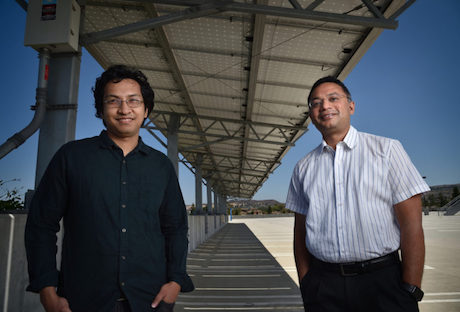
Anomadarshi Barua (left), a UCI doctoral student, and Associate Professor Mohammad Al Faruque figured out a way to disrupt power grids using about $50 worth of equipment hidden in a disposable coffee cup.
Source: Steven Georges / UCI
“Schools all around the world teach kids how to program an Arduino processor,” he said. “Even UCI has camps that teach this technology. However, they would need a little more advanced knowledge to figure out the control part of the system.”
Barua said such an attack could target an individual home or an entire grid. “You could use the device to shut down a shopping mall, an airport or a military installation,” he said.
Al Faruque said this research points out gaps in older technologies that even seasoned experts may have overlooked.