
In 2021, IC3 continued to receive a record number of complaints: 847,376 reported complaints, which was a 7 percent increase from 2020, with potential losses exceeding $6.9 billion. Among the 2021 complaints received, ransomware, business email compromise (BEC) schemes, and the criminal use of cryptocurrency are among the top incidents reported. In 2021, BEC schemes resulted in 19,954 complaints with an adjusted loss of nearly $2.4 billion.
IC3 started up in May 2000 to receive complaints of Internet related crime and has received more than 6.5 million complaints since its inception.
Ransomware Complaints
Over last year, the IC3 received 3,729 complaints identified as ransomware with adjusted losses of more than $49.2 million. Keep in mind these are just the reported incidents. There is a belief within the industry that more cases go unreported than reported.

Ransomware is a type of malicious software, or malware, that encrypts data on a computer, making it unusable. A malicious attacker holds the data hostage until the ransom is paid. If the ransom is not paid, the victim’s data remains unavailable. Cyber criminals may also pressure victims to pay the ransom by threatening to destroy the victim’s data or to release it to the public.
In June last year, IC3 began tracking reported ransomware incidents in which the victim was a member of a critical infrastructure sector. There are 16 critical infrastructure sectors whose assets, systems, and networks, whether physical or virtual, are considered so vital to the United States their incapacitation or destruction would have a debilitating effect on our security, national economy, public health or safety, or any combination thereof.
In October, the IC3 posted a Joint Cybersecurity Advisory (CSA) to ic3.gov regarding ongoing cyber threats to U.S. Water and Wastewater Systems. In September, the IC3 posted a Private Industry Notification (PIN) which warned ransomware attacks targeting the Food and Agriculture sector disrupt operations, cause financial loss, and negatively impact the food supply chain.
Conti Attacks
In May, the IC3 posted an FBI Liaison Alert System (FLASH) report advised the FBI identified at least 16 CONTI ransomware attacks targeting U.S. Healthcare and First Responder networks, including law enforcement agencies, emergency medical services, 9-1-1 dispatch centers, and municipalities within the last year. And in March, the IC3 posted a FLASH warning that FBI reporting indicated an increase in PYSA ransomware targeting education institutions in 12 US states and the United Kingdom.
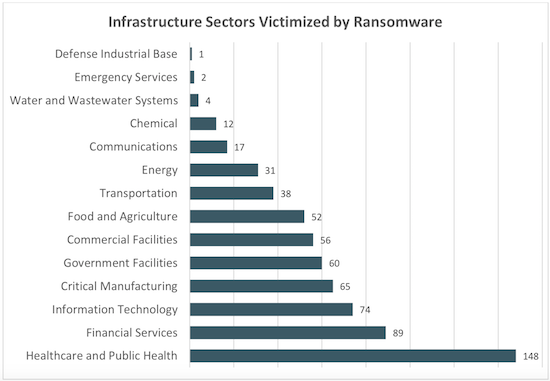
Infrastructure sectors victimized by ransomware.
Source: IC3
The IC3 received 649 complaints that indicated organizations belonging to a critical infrastructure sector were victims of a ransomware attack. Of the 16 critical infrastructure sectors, IC3 reporting indicated 14 sectors had at least 1 member that fell victim to a ransomware attack in 2021.
Of the known ransomware variants reported to IC3, the three top variants that victimized a member of a critical infrastructure sector were CONTI, LockBit, and REvil/Sodinokibi.
CONTI most frequently victimized the critical manufacturing, commercial facilities, and food and agriculture sectors. LockBit most frequently victimized the government facilities, healthcare and public health, and financial services sectors. REvil/Sodinokibi most frequently victimized financial services, information technology, and healthcare and public health sectors.
Ransomware was not the only crime, though. Last year, IC3 received 19,954 Business Email Compromise (BEC)/ Email Account Compromise (EAC) complaints with adjusted losses at nearly $2.4 billion. BEC/EAC is a sophisticated scam targeting businesses and individuals performing transfers of funds. The scam is frequently carried out when a subject compromises legitimate business email accounts through social engineering or computer intrusion techniques to conduct unauthorized transfers of funds.
Romance Scams
Confidence Fraud/Romance scams encompass those designed to pull on a victim’s “heartstrings.” In 2021, IC3 received reports from 24,299 victims who experienced more than $956 million in losses to Confidence Fraud/Romance scams. This type of fraud accounts for the third highest losses reported by victims.
On top of that, IC3 received 34,202 complaints involving the use of some type of cryptocurrency, such as Bitcoin, Ethereum, Litecoin, or Ripple. While that number showed a decrease from 2020’s victim count (35,229), the loss amount reported in IC3 complaints increased nearly seven-fold, from 2020’s reported amount of just over $246.2 million to total reported losses in 2021 of more than $1.6 billion.
Also, tech support fraud involves a criminal claiming to provide customer, security, or technical support or service to defraud unwitting individuals. Criminals may pose as support or service representatives offering to resolve such issues as a compromised email or bank account, a virus on a computer, or a software license renewal.
Click here to view the entire IC3 report.