
At 7:30 a.m. March 18, an oil tank in east Bryan was stricken by lightning and caught fire, creating an earth-shattering boom and sending physical shock waves through the surrounding Austin’s Estates community.
“One of the tanks wound up exploding and going out of the containment area,” said Gerald Burnett, spokesperson for the Bryan Fire Department. “And then the contents from that tank discharged into the containment area around that tank, and the fire in that area ultimately ignited the other tank.”
Burnett said the flames never made it past the tanks’ containment area during the incident, and the surrounding neighborhoods were kept safe – just, maybe a little shaken.

“The direct danger to homes is pretty low,” Burnett said. “That’s not to say there aren’t some exceptions, but that is one of the reasons we don’t want people messing around all the oil pads.”
Firefighters with Bryan FD, and other agencies in the area, train for situations just like this at the industrial fire school hosted by the Texas A&M Engineering Extension Service [TEEX] in College Station.
“In our class what we do [is] try to show both ways to fight those [oil tank] fires,” said Ray McElroy, industrial firefighting instructor with the TEEX Texas Fire Training School. “And we show the types of equipment, you can use to extinguish those types of fires using dry [chemicals], or firefighting foam.”
McElroy said most modern oil tanks are set up with precautions in place, in case a lightning strike or other emergency should happen.
“They’re all designed to be able to manage it within the system, within the dyke area, within the tank,” he said.
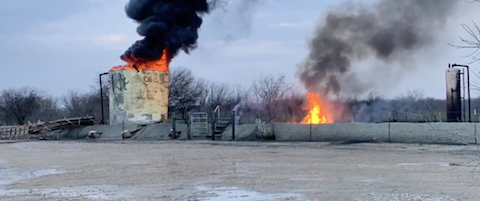
Flames never made it past the tanks’ containment area during a fire that broke out after a lightning strike.
Source: Bryan Fire Department