
The Autonomous, Low-cost, Fast Leak Detection System (ALFaLDS), developed by Los Alamos National Laboratory scientists, can discover accidental releases of methane, a potent greenhouse gas.
ALFaLDS detects, locates and quantifies a natural gas leak based on real-time methane and ethane (in natural gas) and atmospheric wind measurements analyzed by a machine-learning code trained to locate leaks. The code is trained using Los Alamos National Laboratory’s high resolution plume dispersion models and the training is finessed on-site by controlled releases.
Test results using blind releases at an oil and gas well-pad facility at Colorado State University in Fort Collins, Colorado, demonstrated the ALFaLDS locates the engineered methane leaks precisely and quantifies their size.

The capability of locating leaks with high skill, speed and accuracy at lower cost promises new automatic, affordable sampling of fugitive gas leaks at well pads and oil and gas fields, according to the researchers’ paper.
ALFaLDS’s success in locating and quantifying fugitive methane leaks at natural gas facilities could lead to a 90 percent reduction in methane emissions if implemented by the industry.
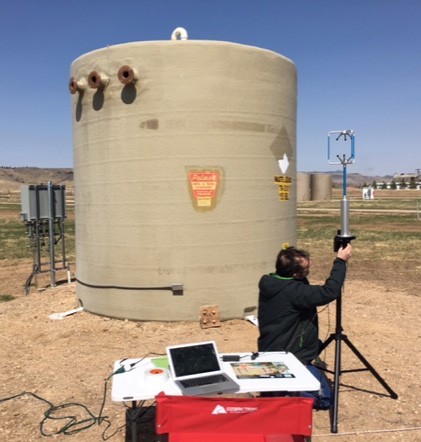
ALFaLDS is deployed during blind tests at the model oil and gas test facility at Fort Collins, Colorado.
ALFaLDS used a small sensor, which makes it ideal for deployment on cars and drones. The Los Alamos team is developing the integrated sensors with a mini 3D sonic anemometer and the powerful machine-learning code in these studies.
However, the code is autonomous and can read data from any gas and wind sensors to help find leaks fast and minimize fugitive emissions from the vast network of natural gas extraction, production and consumption. With this integration, ALFaLDS offers a revolutionary approach for oil and gas service providers in leak detection, to non-profit organizations surveying the issue, and to national laboratories and academia researching natural gas production.