
That may soon be possible with a new software application called the Smart Power Grid Simulator (Smart-PGSim) which uses neural networks, a type of artificial intelligence (AI), to efficiently solve power grid simulations crucial for planning and optimizing electricity delivery. Initial test results showed Smart-PGSim solved power flow calculations about three times faster than a traditional numerical model, without a loss in precision.
Developed by Pacific Northwest National Laboratory (PNNL) computer scientist Gokcen Kestor and collaborators from the University of California, Merced, the methodology behind Smart-PGSim uses a novel neural network approach called multi-task learning modeling.
To keep power flowing at optimum levels, grid operators use offline computer models that crunch data based on a range of scenarios. It’s an iterative process that occurs over and over, all day, every day, and is critical for maintaining grid stability and reliability.

The models must account for highly variable power sources, such as wind and solar, possible power grid failures, and many other contingencies including unexpected increases or decreases in power demand or generation. Depending on the region, the number of power generators alone can range from 1,000 to 1,000,000. Connecting this array of inputs presents an enormous challenge for predictive power grid simulations.
Processing all the data and quickly making sense of it requires a level of programming sophistication on par with the most agile machine of all—the human brain.
Neural networks mimic the way the human brain makes connections in complex relationships through a series of stimulus and activation neurons. Each stimulated neuron activates another neuron and so on, refining the relationship to arrive at meaning. Similarly, using AI neural networks, a computer program can learn to automatically make connections between related layers of data and quickly converge on a solution.
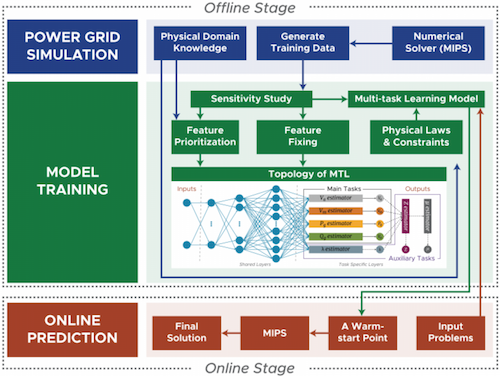
Smart-PGSim can be used to generate a high-quality starting point for online simulation tools to achieve quick convergence.
Source: Graphic by Cortland Johnson|PNNL
For Smart-PGSim, the research team integrated grid-specific domain knowledge into the layers of a multi-task learning model. Physical system constraints, such as generator power, line flow range, and voltage limitations were key to training the model and improving the accuracy, interpretability, and defensibility of the solutions predicted by the model.
“Compared with traditional single-task models, our multi-task model improves accuracy while simplifying the training process,” said Wendy Dong, a University of California, Merced doctoral intern in PNNL’s High-Performance Computing group who worked closely with Kestor throughout the yearlong project. Dong said a well-trained, offline multi-task learning model “can generate a high-quality starting point for online simulation tools to achieve quick convergence.”
Other computational approaches replace a numerical solver with a neural network-based approximation to speed the time-to-solution. However, the approximation degrades the feasibility of the solution—or optimal computational convergence.
“Losing the optimality of computational convergence may translate to a loss of millions of dollars or lack of electricity in critical points, such as hospitals,” Kestor said. “The novelty of our approach is that a neural network is paired with a numerical solver that guarantees the final solution will not lose feasibility.”
While initial results from Smart-PGSim show promising speed, the research team believes that even further improvement is possible through custom hardware AI engines, such as those developed through ARIAA, and by automating some of the manual design work. Such enhancements could allow Smart-PGSim to tackle different applications without the need for an AI engineer to design the neural network.
Kestor said the generality of the techniques the team customized for Smart-PGSim.
“These techniques can be broadly applied to many scientific high-performance computing applications, not just the optimization problem in power grid simulations,” said Kestor. “Other potential applications could include fluid dynamic simulation, molecular dynamics simulation, and cosmology modeling.”