
By simply implementing an appropriate patch management policy, companies can decrease the risk of incidents by 30 percent, and a robust password policy reduces the likelihood of being attacked by 60 percent, according to the Incident Response Analytics report by Kaspersky.
In fact, 63 percent of cyberattacks investigated by the Kaspersky Global Emergency Response team were the result of password brute force attacks and vulnerability exploitation.
Analysis of anonymized data from incident response (IR) cases shows brute force is the most widely used initial vector to penetrate a company’s network. Compared to the previous year, the share of brute force attacks has jumped from 13 percent to 31.6 percent, likely due to the pandemic and the boom of remote working. The second most commonly seen attack is vulnerability exploitation with a 31.5 percent share. The research showed in only a few incidents, vulnerabilities from 2020 were used. In other cases, adversaries utilized older unpatched vulnerabilities such as CVE-2019-11510, CVE-2018-8453, and CVE-2017-0144.

More than half of all attacks that started with malicious emails, brute force, and external application exploitation were detected in hours (18 percent) or days (55 percent), however some of these attacks lasted much longer, with an average duration of up to 90.4 days. This report shows attacks involving a brute force initial vector are easy to detect in theory, but in practice, only a fraction were identified before causing an impact.
Although brute force attack prevention and the control of timely updates do not seem to be problematic for a professional cybersecurity team, in practice, 100 percent elimination of these issues is virtually impossible:
“Even if the IT security department does its best to ensure safety of the company’s infrastructure, factors such as legacy OS usage, low-end equipment, compatibility issues and human factors often result in security breaches that can jeopardize an organization’s security,” said Konstantin Sapronov, head of global emergency response team. “Protective measures alone can’t provide holistic cyber defense. Therefore, they should always be combined with detection and response tools that are able to recognize and eliminate an attack at an early stage, as well as address the cause of the incident.”
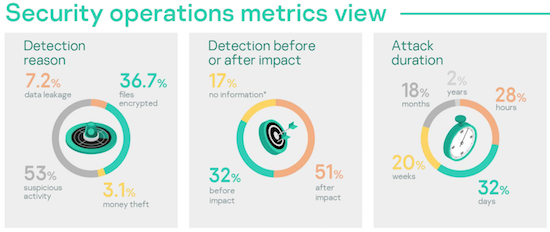
Source: Kaspersky
To minimize the chances of penetration to your infrastructure, Kaspersky recommends the following measures:
- Implement a robust password policy, including multifactor authentication (MFA) and identity and access management tools.
- Ensure patch management or compensation measures for public-facing applications have zero tolerance. Regular updates of vulnerability details from software vendors, scanning the network for vulnerabilities and patch installations are crucial for the security of a company’s infrastructure;
- Maintain a high level of security awareness among employees. Conducting comprehensive and effective third-party training programs for employees is a good way to save time of IT department and get good results;
- Implement an endpoint eetection and response solution to detect and react to attacks promptly, among other measures.
Click here for the full report.