
After an investigation by the Bureau of Safety and Environmental Enforcement (BSEE), a panel concluded the cause of the fatality and serious injury was the failure of the construction crew and authorizing personnel to recognize the moisture barrier was not a walking/working surface, and that it could not support their weight. The victim and the injured worker’s combined weight caused the barrier to break, which resulted in them falling approximately 80 feet into the Pacific Ocean.
A three-member construction crew, employed by DCOR, was repairing a section of the galley floor in the main living quarters, on the first floor, that had sustained water damage.
The main living quarters building is at the drill deck level. The flooring consisted of a layer of linoleum, a 4-by-8-feet sheet of 1-inch plywood, a 1.5-by-3-inch wooden floor joist, and a 5-millimeter composite flooring (moisture barrier) material set on top of a steel frame. The crew removed the damaged material in a 7-by-7-feet area of the galley floor, leaving only the 5-millimeter moisture barrier.

At approximately noon, as the victim replaced the wood floor joists while standing on the 5-millimeter moisture barrier material, a welder, the injured worker, exited the kitchen area, walked around the outside of the living quarters, then into the galley.
The injured worker continued across the galley floor, then stepped into the unbarricaded work area and onto the 5-millimeter moisture barrier. The weight of the injured worker stepping onto the moisture barrier caused it to collapse. The injured worker and victim fell through the floor and 80 feet into the Pacific Ocean. The injured worker swam back to the platform where he was assisted out of the water by platform personnel. Realizing the victim could not swim, a few of the platform workers jumped in the water, against the orders of the Person-in-Charge (PIC), in an attempt to rescue him.
The victim was manually lifted onto the plus 14-foot deck where platform personnel initiated CPR, then transferred the victim to a motor vessel. CPR and medical care continued until the crew boat arrived at Ventura Harbor, at which time the victim was transported, by ambulance, to Ventura County Medical Center, where he was pronounced dead.
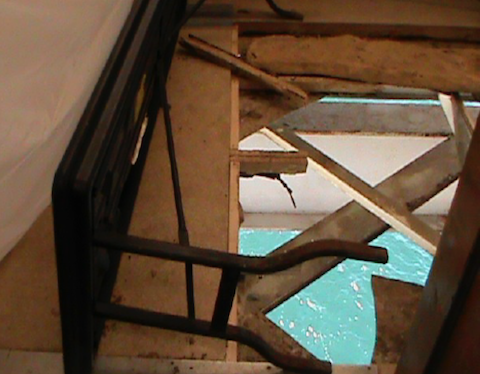
Galley flooring inside the living quarters that gave away after too much weight was placed on the moisture barrier.
Source: BSEE
An autopsy report summarized the cause of the victim’s death as an accidental drowning
The injured worker was transported by a medical helicopter to St. John’s hospital in Oxnard, CA.
BSEE conducted a panel investigation into the incident and the causal factors that led to the incident. A member of the panel traveled to Platform Gilda and conducted interviews, reviewed pertinent documents, and took photographs of the scene. Additionally, the panel conducted witness interviews. The panel also collected and reviewed additional documents, statements, records, photographs, diagrams, and videos.
Based on findings of the investigation, the panel concluded the cause of the fatality and serious injury was the failure of the construction crew and authorizing personnel to recognize that the 5-millimeter moisture barrier was not a walking/working surface, and that it could not support their weight.
Considering the totality of circumstances, the panel concluded the death of the victim was the result of:
- The work crews’ or appropriate personnel’s negligence to place a barrier around the area to prevent unsafe access into the work area by unauthorized/other workers.
- Failure of the construction crew, the supervisor, and/or qualified designee to inspect the work area, or to review relevant engineering drawings to verify structural integrity of the flooring materials prior to starting the task.
- The crew’s lack of situational awareness the 5-millimeter moisture barrier was not a walking surface. The injured worker stepped into the work area causing it to collapse, resulting in the injured worker and victim falling into the Pacific Ocean.
In addition, the panel identified the following contributing causes:
- The victim’s incorrect identification of the composite flooring material as metal created, in other personnel, a false sense of security the surface was load bearing.
- Failure of the site supervisor to ensure an adequate Job Safety Analysis (JSA) was conducted to help identify, understand, and communicate all hazards associated with the job to personnel before repair of the galley floor.
- The construction crew did not recognize the changes in work scope to utilize Stop Work Authority (SWA) and to verify an unfamiliar part of the floor.
- The victim could not swim.
As a result of the investigation, BSEE recommended:
- Operators develop task-specific JSAs for every task and ensure they are implemented in each stage of the task.
- The Ultimate Work Authority, or qualified designee, review and approve the effectiveness of any barriers prior to the task(s) and communicate all associated hazards to all personnel.
- Operators evaluate the effectiveness of facilities permitting system including the human factors elements.
- Operators train employees on water emergency rescue and associated risk to avoid further injuries to personnel.
- Rescues should be strictly based on the operator’s emergency rescue policy and procedures including fall and water emergencies.
- Operators consult relevant drawings during the planning phase of any task to help understand any risk associated with the intended task or project.