
This company specializes in putting together reliability maintenance-based programs for companies in the food, manufacturing, power, oil and gas, and other industries.
After an unexpected OSHA enforcement visit in January of 2013, the company decided they wanted full knowledge of the workplace safety and health regulations and resources available to them. That is when they called the OSHA Nebraska On-Site Consultation Program.
Hazards included a lack of a central location for safety data sheets, incorrect or missing labels for chemicals, and tools/equipment improperly maintained or needed repair. In addition to correcting all the hazards, the company put a “champion” in charge of the safety and health program and conducted thorough reviews on every aspect of the program.

After an additional safety and health visit, the company implemented monthly safety inspections and quarterly safety trainings.
In February of 2017, USPI received initial recognition into OSHA’s Safety and Health Achievement Recognition Program (SHARP).
The company received renewals in 2019 and most recently in March this year.
SHARP acknowledges small and medium-sized businesses that have used OSHA On-Site Consultation Program services and operate exemplary workplace safety and health programs. Small businesses that achieve SHARP status receive a deferral from OSHA or the State Plan programmed inspections for the period the SHARP designation is valid. Acceptance of a worksite into SHARP is an achievement that identifies the employer as a model for occupational safety and health among its business peers.
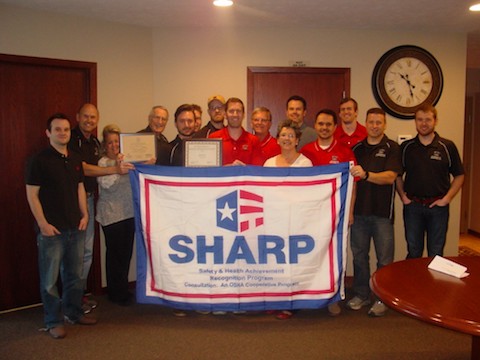
The staff of US Petrolon in Lincoln, Nebraska, during their first SHARP recognition ceremony in 2017.
From 2014 until May 2021, USPI has not experienced any workplace illnesses or injuries. In contrast, for NACIS Code 333318, the U.S. Bureau of Labor Statistics reported the national average total recordable case (TRC) rate for 2019 was 2.8, and the national average days away, restricted, and/or transfer (DART) rate was 1.2. Low TRC and DART rates in such a high-hazard industry significantly reduces USPI’s worker compensation insurance premiums and claims costs. Having the safety and health program involve people from all levels of the organization in identifying and correcting hazards has also proven to be cost effective.
“We made sure every employee knew how to perform their tasks in a safe manner and how to respond to different scenarios,” said Viktor Nurbabayev, USPI Sales/Engineering Manager. “Everyone got involved, and it led to a successful program with employees who bought into the vision.”