
The technology has the potential to serve millions of users, is understood to be the largest-ever quantum network of its kind, and could end up used to secure people’s online communication, particularly in these Internet-centric times accelerated by the COVID-19 pandemic, said researchers at the University of Bristol in the UK, who wrote a paper on the subject.
This new technique, which harnesses the simple laws of physics, can make messages completely safe from interception while also overcoming major challenges which have previously limited advances in this little used but much-hyped technology.
Compelling Quantum Case
The current Internet relies on complex codes to protect information, but hackers are increasingly adept at outsmarting such systems leading to cyber-attacks across the world which cause major privacy breaches and fraud running into trillions of pounds annually. With such costs projected to rise dramatically, the case for finding an alternative is even more compelling and quantum has for decades been hailed as the revolutionary replacement to standard encryption techniques.

So far physicists have developed a form of secure encryption, known as quantum key distribution, in which particles of light, called photons, are transmitted. The process allows two parties to share, without risk of interception, a secret key used to encrypt and decrypt information. But to date this technique has only been effective between two users.
“Until now efforts to expand the network have involved vast infrastructure and a system which requires the creation of another transmitter and receiver for every additional user. Sharing messages in this way, known as trusted nodes, is just not good enough because it uses so much extra hardware which could leak and would no longer be totally secure,” Joshi said.
The team’s quantum technique applies a seemingly magical principle, called entanglement, which Albert Einstein described as “spooky action at a distance.” It exploits the power of two different particles placed in separate locations, potentially thousands of miles apart, to simultaneously mimic each other. This process presents far greater opportunities for quantum computers, sensors, and information processing.
“Instead of having to replicate the whole communication system, this latest methodology, called multiplexing, splits the light particles, emitted by a single system, so they can be received by multiple users efficiently,” Joshi said.
Efficient Network
The team created a network for eight users using just eight receiver boxes, whereas the former method would need the number of users multiplied many times – in this case, amounting to 56 boxes. As the user numbers grow, the logistics become increasingly unviable – for instance 100 users would take 9,900 receiver boxes.
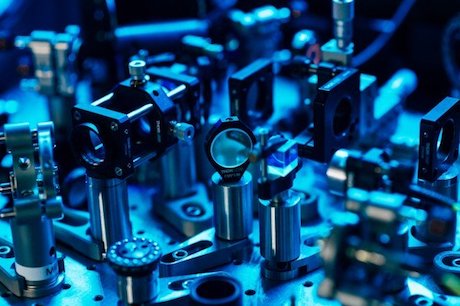
A quantum physics experiment has demonstrated an important step toward quantum cryptography between users, an essential requirement for a secure quantum Internet.
Source: ÖAW/Klaus Pichler
To demonstrate its functionality across distance, researchers connected the receiver boxes to optical fibers via different locations across Bristol and they tested the ability to transmit messages via quantum communication using the city’s existing optical fiber network.
“Besides being completely secure, the beauty of this new technique is its streamline agility, which requires minimal hardware because it integrates with existing technology,” Joshi said.
The team’s unique system also features traffic management, delivering better network control which allows, for instance, certain users to be prioritized with a faster connection.
Whereas previous quantum systems have taken years to build, at a cost of millions or even billions of dollars (or pounds), this network was created within months for less than $399,000 (£300,000). The financial advantages grow as the network expands, so while 100 users on previous quantum systems might cost in the region of $6.7 billion (£5 billion), Dr Joshi believes multiplexing technology could slash that to $6 million (£4.5 million), less than 1 percent.
Economies of Scale
In recent years quantum cryptography has been successfully used to protect transactions between banking centers in China and secure votes at a Swiss election. Yet, its wider application has been held back by the sheer scale of resources and costs involved.
“With these economies of scale, the prospect of a quantum Internet for universal usage is much less far-fetched. We have proved the concept and by further refining our multiplexing methods to optimize and share resources in the network, we could be looking at serving not just hundreds or thousands, but potentially millions of users in the not too distant future,” Joshi said.
“The ramifications of the COVID-19 pandemic have not only shown importance and potential of the Internet, and our growing dependence on it, but also how its absolute security is paramount. Multiplexing entanglement could hold the vital key to making this security a much-needed reality.”