
Among the various approaches to tackle this issue, researchers have used semiconductor technology to improve the safety of Li-ion batteries.
The latest development comes from a research team from the Korea Institute of Science and Technology (KIST) led by Dr. Joong Kee Lee of the Center for Energy Storage Research which succeeded in inhibiting the growth of dendrites, crystals with multiple branches that cause EV battery fires by forming protective semiconducting passivation layers on the surface of Li electrodes.
To prevent dendrite formation, the research team exposed fullerene (C60), a highly electronic conductive semiconductor material, to plasma, resulting in the formation of semiconducting passivation carbonaceous layers between the Li electrode and the electrolyte. (Fullerene is a particular physical form of carbon in which 60 carbon atoms are connected by single and double bonds in a pentagonal shape to form a soccer ball-like shape.) The semiconducting passivation carbonaceous layers allow Li-ions to pass through while blocking electrons due to the generation of Schottky barrier, and by preventing electrons and ions from interacting on the electrode surface and inside, they stops the formation of Li crystals and the consequent growth of dendrites.

The stability of the electrodes with the semiconducting passivation carbonaceous layers was tested using Li/Li symmetric cells in extreme electrochemical environments where typical Li electrodes remain stable for up to 20 charge/discharge cycles.
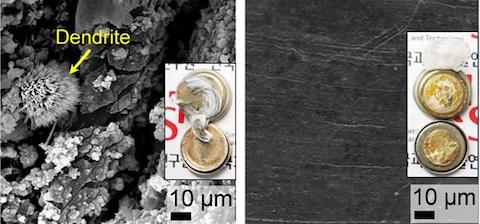
Top-view SEM images and photographs (inset) of plain-Li, and Li@p-PCL electrodes after cycling tests with Li|Li symmetrical cells at 1.0 mA cm-2 and 1.0 mAh cm-2.
Source: Korea Institute of Science and Technology
The newly developed electrodes showed significantly enhanced stability, with Li dendrite growth suppressed for up to 1,200 cycles. Moreover, using a lithium cobalt oxide (LiCoO2) cathode in addition to the developed electrode, approximately 81 percent of the initial battery capacity was maintained after 500 cycles, representing an improvement of approximately 60 percent over conventional Li electrodes.
“The effective suppression of dendrite growth on Li electrodes is instrumental for improving battery safety,” Lee said. “The technology for developing highly safe Li-metal electrodes proposed in this study provides a blueprint for the development of next-generation batteries that do not pose a fire risk.”
Lee’s next goal is improving the commercial viability of this technology.
“We aim to make the fabrication of the semiconducting passivation carbonaceous layers more cost-effective by substituting fullerene with less expensive materials,” Lee said.