
In nearly every threat category, the numbers for September were doing one of two things: Rising, or skyrocketing, according to SonicWall’s Q3 cyber threat intelligence data. Between packed hospitals, unsecure remote students and workers, and the most high-profile presidential election in history, there have never been so many potential vulnerable victims to attack.
SonicWall, which blocks an average of more than 28 million malware attacks globally each day, recorded 4.4 billion malware attacks and 199.7 million ransomware attacks globally through the first three quarters of 2020, a year-over-year decrease of 39 percent and increase of 40 percent, respectively.
Overall in Q3 2020 malware has continued to drop, falling to 4.4 billion hits. The news was even better in some areas; for example, in Germany malware dropped by nearly two-thirds, and in India it fell by nearly 70 percent, according to SonicWall data.

It’s worth noting, however, that Q3 ended on a much-less-optimistic note. As you’d expect with such a decrease, only two months in 2020 registered an increase in malware: May and September. May’s (relatively) modest gain of 13.3 million was little more than a blip, and quickly reversed itself.
The increase in September, however, is significantly more worrying, researchers said. First of all, the increase between August and September is nearly five times as large as that between April and May, and added a total of 59 million hits.
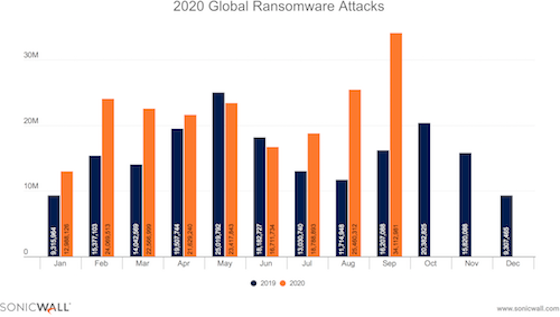
Ransomware dramatically climbed in the third quarter this year.
Source: SonicWall
When it comes to ransomware, however, it is a different story. The number of ransomware hits during the first half of the year was up 20 percent over the same time period in 2019. But with June registering a slight decrease, researchers thought this would mark the beginning of a trend, and that ransomware’s reign of terror would slow down.
It turns out the opposite occurred. As the 20 percent increase at the end of Q2 grew to a 40 percent increase by the end of Q3. While that’s worrying enough, the pace of this increase offers further cause for concern.
After a small increase of 12.4 percent from June to July (16.7 million to 18.8 million), August and September continued to pick up momentum. Between July and August, total ransomware rose from 18.8 million to 25.5 million, and then from August to September it jumped even more, from 25.5 million to 34.1 million.
Much of this increase is coming from the precipitous rise in the number of Ryuk detections. First discovered in August 2018, Ryuk is a relatively young ransomware family, and one that got off to a slow start among SonicWall customers.
Through Q3 2019, SonicWall detected just 5,277 Ryuk attacks. Through Q3 2020, SonicWall detected 67.3 million Ryuk attacks. Not only does this amount to a gigantic 1,275,245 percent increase, it also represents more than a third of all ransomware attacks so far this year.
Ryuk is especially dangerous because it’s targeted, manual and often leveraged via a multi-stage attack (Emotet > Trickbot > Ryuk).
In SonicWall’s mid-year update, researchers noted, if the patterns we were seeing at the time held, total IoT attacks for 2020 would surpass 2018 and 2019 levels.
Now, with an entire quarter left to go, we’ve already nearly reached that point, researchers said. Through Q3, SonicWall registered 32.4 million IoT malware attacks, closing in on 2019’s total of 34.4 million attacks and 2018’s total (32.7 million attacks).