
Spyware is the most common malware class hiding in fraudulent COVID-19 emails, with AgentTesla topping the list of phishers’ favorite attacks, researchers said.
In addition, coronavirus has split the hacker underground into those who capitalize on the pandemic and those who oppose exploiting the crisis, according to researchers at Group-IB, who said users must remain vigilant and pay close attention to any emails about coronavirus.
Singapore-based Group-IB’s Computer Emergency Response Team’s (CERT-GIB) report is based on analyses of coronavirus-related phishing traffic by the Threat Detection System (TDS) Polygon as part of operations to prevent threats spread online.
Most COVID-19-related phishing emails analyzed had different spyware strains embedded as attachments. AgentTesla (45 percent), NetWire (30 percent), and LokiBot (8 percent) were the most actively exploited malware families, researchers said. With some minor differences, the goal of all these malware samples are to collect personal and financial data. They can retrieve user credentials from browsers, mail clients and file transfer protocol (FTP) clients, capture screenshots, and secretly track user behavior and send it to cybercriminals’ command and control centers.

Most of the emails detected were in English, researchers said. Those behind COVID-related campaigns target government organizations and private companies. The emails were masked as advisories, purchase orders, face masks offers, and alerts or safety recommendations from the World Health Organization, UNICEF, and other international agencies and private companies such as Maersk, Pekos Valves, and CISCO. Keep in mind, those companies are not involved in the attacks.
Cybercriminals used the following file extensions to deliver malware samples: .gz, .ace, .arj, and .rar, three of which are archive formats. It’s worth noting .rar also became the second commonly used format to deliver archived malware in H1 2019 and accounted for 25 percent of all archived malicious files detected by Group-IB’s CERT in the first half of 2019. To trick antivirus software, attackers include the passwords for accessing the content in the email subject line, in the archive name, or in subsequent correspondence with the victim. Unless behavioral analytics is employed, such malware is likely to remain undetected.
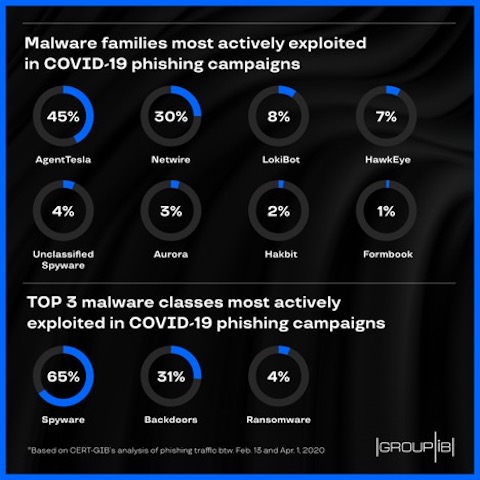
Spyware is the most common malware class hiding in fraudulent COVID-19 emails, while AgentTesla heads to list of phishing attacks.
Source: Group-IB
Phishing emails exploiting coronavirus panic accounted for about 5 percent of all malicious emails detected and analyzed by CERT-GIB over the review period. This relatively small percentage can partly be explained by the fact not all cybercriminals are capitalizing on coronavirus fears. According to media reports, some ransomware gangs have stated they will not target medical organizations during the outbreak. Group-IB’s Threat Intelligence team has also detected a number of underground forum posts by users who urge others to stop exploiting COVID-19 for malicious purposes.
While it has been stated already, but it is worth mentioning again, remote work increases the likelihood of cyberattacks.
“People should remain particularly vigilant now that most people are working from home due to the pandemic,” said Aleksandr Kalinin, head of Group-IB’s Computer Emergency Response Team (CERT-GIB). “We predict an increase in the number of cyberattacks on unprotected home networks used by employees who have switched to remote work as the virus spreads offline. Corporate security teams should reassess their approach to securing corporate digital space by strengthening their perimeter, which now includes employees’ home devices. A single employee who opens a malicious file from an undetected phishing email could jeopardize the whole company’s operations.”
All remote employees’ email accounts as well as the VPNs used to access corporate networks should be protected with two-factor authentication at least. Moreover, implementing network protection solutions is needed to analyze incoming and outgoing emails. Network segmentation and access right differentiation are both required. It is also recommended that even remote user activity be covered by the organization’s perimeter security tools.