
More than twice as many people — including homeowners, commuters, police and fire first-responders and hospital personnel — ended up exposed and treated in April in Beach Park, IL, during a hazardous material incident than initially reported, officials said.
A lack of communication led to healthcare providers and first-responders exposing themselves to a toxic gas after the release of an agricultural fertilizer that created a fog, according to a report by the Centers for Disease Control and Prevention (CDC) released Thursday.
Authorities reported in the past the incident sent 41 people to area hospitals, including 11 fire and police personnel, and required residents in a one-mile area to shelter in place or evacuate, according to a National Transportation Safety Report released in June.
The CDC report said 83 people were evaluated at six area hospitals for effects of the chemical release. Fourteen were admitted, including eight who were placed in an intensive care unit, and all but one required endotracheal intubation, where a tube is placed into the windpipe through the mouth or nose along with mechanical ventilation, according to the CDC report.

The leak occurred at approximately 4:30 a.m. on April 25, when about 750 gallons of anhydrous ammonia liquefied compressed gas accidentally released from two 1,000-gallon nurse tanks mounted on a farm trailer being pulled by a John Deere tractor, according to a U.S. National Transportation Safety Board preliminary report on the investigation released on June 11.
“While traveling between farm fields, the driver said that he heard a ‘puff’ sound. When he turned his head around to see the nurse tanks, he saw a gas cloud.
Exposure to the anhydrous ammonia gas can cause severe respiratory problems and damage to the eyes, sometimes causing visual impairment, according to the CDC. Victims reported shortness of breath, cough, upper airway pain, headaches, dizziness, chest tightness, chest pain, eye pain, wheezing and nausea.
No deaths occurred, and one hospital reported that it began to decontaminate admitted patients after five of its intensive care unit staff members experienced symptoms of secondary exposure from removing anhydrous ammonia from victims’ clothing, according to the CDC.
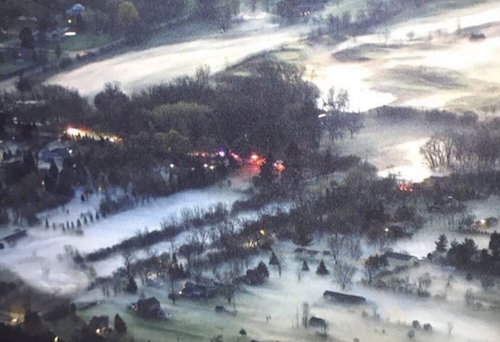
The Beach Park Fire Department received this drone picture at dawn on the day of the ammonia leak in Beach Park.
Source: Beach Park Fire Department
“First-responders, community residents, and hospital staff reported communication challenges. Confusion among dispatchers about the source of the ‘smoke’ led to a delay in recognizing this as a hazardous ammonia release and resulted in the first-responders initially not using the appropriate protective equipment,” the report found.
Because of limited information about the nature of the anhydrous ammonia exposure, initial calls by hospitals to the poison control center resulted in inadequate and incomplete recommendations, according to the CDC, especially regarding decontamination.
“Although the probability of hazmat incidents of this magnitude is low, the incidents are of high consequence and threaten first-responders and the public. Multi-agency hazmat trainings will improve communications, identify communication gaps, and clarify each agency and responder’s role during a response,” according to the report.