
It is so easy for dust to build up in agricultural, powder-handling or manufacturing settings, but that also causes extreme hazards to employees and poses a risk of exploding at any moment. That is why dust explosions are among the most dangerous and costly workplace incidents.
Having said that, there is a new image- and video-based application in development using OpenCV algorithms that detect suspended dust concentration, said researchers at Purdue University. The app uses a camera or a video recording device to image and determine suspended dust, as well as accurately distinguish it from normal background noise.
“Determining suspended dust concentration allows employers to take appropriate safety measures before any location within the industry forms into an explosive atmosphere,” said Kingsly Ambrose, an associate professor of agricultural and biological engineering who leads the research team. “I believe this technology could help prevent dust explosions and will be of great benefit to the industry.”
Ambrose said current technology for detecting dust levels is inconvenient because it is expensive, difficult to install in a workspace and separates dust matter into multiple filters that must be weighed and further manipulated for analysis.

In powder handling and processing industry, location of dust emission can vary, with the suspended dust concentration assessment requiring installation of an immovable or wired equipment. For increased dust sensing, not limited by location within the facility, a portable suspended dust concentration measuring system would end up being preferential.
In the Purdue study, researchers developed a new method of sensing suspended dust concentration under daylight environment using the change in light extinction coefficient. The method involves capturing images of the suspended dust cloud and then analyzing the light extinction coefficient. This method mitigated the environmental light scattering and absorption and eliminated the noise from the images obtained through a camera by calibration between two targets.
Ambrose said in testing, the algorithm successfully recognized 95 percent of saw dust and 93 percent of cornstarch particulates in the air. Researchers also tested corn dust and sawdust.
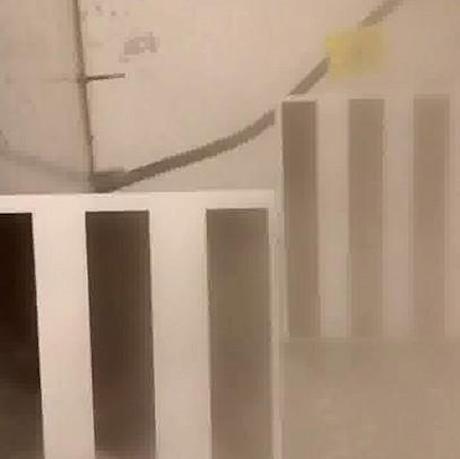
An image- and video-based application using OpenCV algorithms that detect explosible suspended dust concentration is now in development. The app uses a camera or a video recording device to image and determine suspended dust.
Source: Kingsly Ambrose/Purdue University
The light extinction coefficient correlated with the suspended dust concentration, and the extinction coefficient values depended on the dust properties. Mass extinction coefficient (K) was obtained for cornstarch, saw dust and corn dust, from known suspended dust concentrations using image analysis. The mass extinction coefficient of the three sample materials tested in this study were in the range of 0.03–0.04. This method of using light extinction coefficient can be used for real-time sensing of suspended dust concentration in open and confined spaces.
“This technology is unique because it is easy to use without extended training, location independent and does not require permanent installations,” Ambrose said.
Ambrose and the team have worked with the Purdue Research Foundation Office of Technology Commercialization to patent the technology. They are looking to license it and are seeking collaborators for further development.