
There is a process in development to incorporate electronic sensors into stretchy fabrics, allowing them to create shirts or other garments that can monitor vital signs such as temperature, respiration, and heart rate.
The sensor-embedded garments, which are machine washable, can end up customized to fit close to the body of the person wearing them, said researchers at MIT.
“We can have any commercially available electronic parts or custom lab-made electronics embedded within the textiles that we wear every day, creating conformable garments,” said Canan Dagdeviren, the LG Electronics Career Development Assistant Professor of Media Arts and Sciences at MIT. “These are customizable, so we can make garments for anyone who needs to have some physical data from their body like temperature, respiration rate, and so forth.”
Dagdeviren is the senior author of a paper describing the new material. MIT graduate student Irmandy Wicaksono is the lead author of the study.

Other research groups have developed thin, skin-like patches that can measure temperature and other vital signs, but these are delicate and must end up taped to the skin. Dagdeviren’s lab set out to create garments more similar to the clothes we normally wear, using a stretchy fabric that has removable electronic sensors incorporated into it.
“In our case, the textile is not electrically functional. It’s just a passive element of our garment so that you can wear the devices comfortably and conformably during your daily activities,” Dagdeviren said. “Our main goal was to measure the physical activity of the body in terms of temperature, respiration, acceleration, all from the same body part, without requiring any fixture or any tape.”
The electronic sensors consist of long, flexible strips encased in epoxy and then woven into narrow channels in the fabric. These channels have small openings that allow the sensors to touch the skin. For this study, the researchers designed a prototype shirt with 30 temperature sensors and an accelerometer that can measure the wearer’s movement, heart rate, and breathing rate. The garment can then transmit this data wirelessly to a smartphone.
The researchers chose their fabric – a polyester blend – for its moisture-wicking properties and its ability to conform to the skin, similar to compression shirts worn during exercise. Last summer, several of the researchers spent time at a factory in Shenzhen, China, to experiment with mass-producing the material used for the garments.
“From the outside it looks like a normal T-shirt, but from the inside, you can see the electronic parts which are touching your skin,” Dagdeviren said. “It compresses on your body, and the active parts of the sensors are exposed to the skin.”
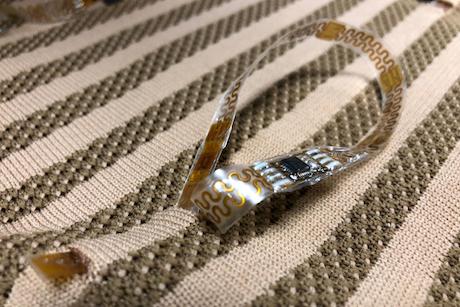
It is possible to place electronic sensors into stretchy fabrics, allowing them to create shirts or other garments that can monitor vital signs.
Source: MIT Media Lab
A person could wash the garments with the sensors embedded in them, and the sensors can also end up removed and transferred to a different garment.
The researchers tested their prototype shirts as wearers exercised at the gym, allowing them to monitor changes in temperature, heart rate, and breathing rate. Because the sensors cover a large surface area of the body, the researchers can observe temperature changes in different parts of the body, and how those changes correlate with each other.
The shirts can come in different sizes to fit an array of ages and body types, Dagdeviren said. She plans to begin developing other types of garments, such as pants, and is working on incorporating additional sensors for monitoring blood oxygen levels and other indicators of health.