
Identifying sources of light plays an important role in the development of photonic technologies, such as lidar, remote sensing, and microscopy.
Traditionally, identifying light sources as diverse as sunlight, laser radiation, or molecule fluorescence has required millions of measurements, particularly in low-light environments, which limits the realistic implementation of quantum photonic technologies. Having said all that, there is a smart quantum technology in development that enables a dramatic reduction in the number of measurements required to identify light sources, researchers said.
“We trained an artificial neuron with the statistical fluctuations that characterize coherent and thermal light,” said Omar Magana-Loaiza, a physics professor at Louisiana State Unversity and an author of a paper on the subject.
After researchers trained the artificial neuron with light sources, the neuron could identify underlying features associated with specific types of light.

“A single neuron is enough to dramatically reduce the number of measurements needed to identify a light source from millions to less than hundred,” said Chenglong You, a fellow researcher and co-author on the paper.
With fewer measurements, researchers can identify light sources much more quickly, and in certain applications, such as microscopy, they can limit light damage since they don’t have to illuminate the sample nearly as many times when taking measurements.
“If you were doing an imaging experiment with delicate fluorescent molecular complexes, for example, you could reduce the time the sample is exposed to light and minimize any photodamage,” said Roberto de J. León-Montiel, another co-author.
Cryptography is another application where these findings could prove valuable. Typically to generate a key to encrypt an email or message, researchers need to take millions of measurements. “We could speed up the generation of quantum keys for encryption using a similar neuron,” said Magana-Loaiza.
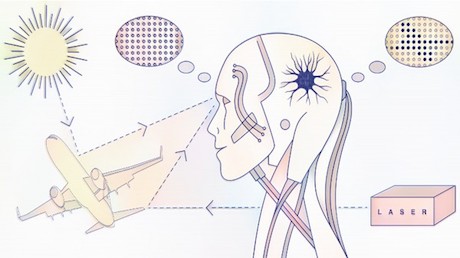
A detector (the eye) measures identical photons from natural sunlight and laser light. The fast identification of light sources is performed by an artificial neuron trained to efficiently extract patterns in the quantum fluctuations of photons.
Source: Elsa Hahne
As laser light plays an important role in remote sensing, this work could also enable development of a new family of smart lidar systems with the capability to identify intercepted or modified information reflected from a remote object. Lidar is a remote sensing method that measures distance to a target by illuminating the target with laser light and measuring the reflected light with a sensor.
“The probability of jamming a smart quantum lidar system will be dramatically reduced with our technology,” he said. In addition, the possibility to discriminate lidar photons from environmental light such as sunlight will have important implications for remote sensing at low-light levels.