
A badly corroded pipe elbow, which had reached about half the thickness of a credit card, appears to have ruptured in the Philadelphia Energy Solutions (PES) Refinery’s alkylation unit, releasing process fluid that included over 5,000 pounds of hydrofluoric acid, or HF, federal investigators found.
As a result, the leaking process fluid formed a large ground-hugging vapor cloud and within two minutes, the cloud ignited, causing a massive fire and explosions on June 21, according to a factual update from the Chemical Safety Board (CSB).
“Since 2015, the CSB has investigated three major incidents at refineries that utilize HF for alkylation,” said CSB Interim Executive Dr. Kristen Kulinowski. “Incidents in Superior, WI, and Torrance, CA, fortunately did not result in an HF release.
“That was not the case here in Philadelphia. Though the main tank holding HF was not breached, HF was a component of the process fluid released from the alkylation unit. We are lucky there were no serious injuries or fatalities.”

While the CSB’s investigation is still ongoing, the factual update released more details of the incident collected through interviewing witnesses, gathering evidence and ultimately, piecing together the events that led to the explosion:
• The piping was susceptible to corrosion from the hydrofluoric acid that was in the process fluid. The elbow that ruptured corroded faster than the rest of the piping in this part of the process.
• While pipe thickness in this section of the unit was periodically measured to monitor corrosion rates, the thickness of the elbow that failed had not been monitored for corrosion. The piece of piping that failed had a high nickel and copper content. Various industry publications have found that carbon steel with a higher percentage of nickel and copper corrodes at a faster rate than carbon steel with a lower percentage when used in a process with hydrofluoric acid.
• A secondary event at the PES refinery occurred when the V-1 Treater Feed Surge Drum ruptured, which launched a fragment of the vessel weighing 38,000 pounds across the Schuylkill River. Two other large fragments landed within the PES Refinery.

Security camera footage of leaking process fluid. It formed a large ground-hugging vapor cloud that surrounded some sections of the unit. Within minutes after the cloud formed, it ignited.
Source: Credit: PES
“Corrosion is not a new issue for the CSB,” said CSB Supervisory Investigator Lauren Grim. “In its prior investigation of a 2012 Chevron Refinery fire we determined that corrosion caused the rupture of a piping component. Similarly, the 2009 Silver Eagle refinery fire was also caused by the failure of piping that had thinned due to corrosion.”
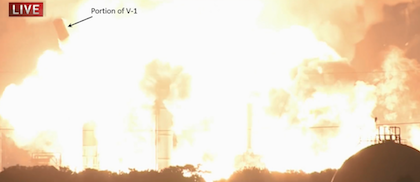
Video still of V-1 explosion. A secondary explosion at the refinery was when the V-1 Treater Feed Surge Drum ruptured, which launched a fragment of the vessel, shown in photo, weighing 38,000 pounds across the Schuylkill River.
Source: NBC10 Philadelphia
Kulinowski said moving forward the CSB is examining the need for more robust reviews of corrosion mechanisms as well as looking more closely at the use of HF in the refining process.