
Hurricane season started up with a vengeance so far this year with two named storms that hit even before the season even started.
That line of thinking, and remembering the sobering effects from Hurricane Harvey just three short years ago, led the Chemical Safety Board (CSB) to issue an alert to get everyone thinking about preparedness plans.
That is why the CSB issued a video safety message and a safety alert entitled “2020 Hurricane Season: Guidance for Chemical Plants During Extreme Weather Events.” The video and safety alert highlight actions by the Center for Chemical Process Safety (CCPS) to produce industry guidance meant to help hazardous chemical facilities better prepare for extreme weather events.
Arthur and Bertha were the first two named Atlantic storms of 2020, and they both formed in May.

June 1 is the official start of hurricane season, but occasionally, storms form earlier than that date. Arthur formed well east of Florida on May 16, and Bertha developed near the South Carolina coast on May 27.
There are only four other years in the Atlantic dating to 1851 where two storms have reached tropical storm intensity before May 27. That last happened in 2012, followed by 1951, 1908 and 1887, according Dr. Phil Klotzbach, a tropical scientist at Colorado State University.
“As the nation faces this year’s hurricane season, it is critical that the chemical industry understand and prepare for the potential safety hazards posed by extreme weather events,” said CSB Chairman Katherine Lemos in the agency’s video.
On August 31, 2017, fires erupted at the Arkema Chemical Plant in Crosby, Texas, as a result of heavy rain from Hurricane Harvey. Plant equipment flooded and failed causing chemicals stored at the facility to decompose and burn, releasing fumes and smoke into the air. Twenty-one people sought medical attention from reported exposures to the fumes. More than 200 residents living nearby the facility were evacuated and could not return home for a week.
The CSB’s investigation found a significant lack of industry guidance on planning for flooding or other severe weather events, and called on CCPS to produce such guidance so incidents like the one at the Arkema plant can be prevented. CCPS released that guidance, called “Assessment of and Planning for Natural Hazards,” which provides an updated approach for assessing natural hazards, means to address the hazards, and emergency planning.
“The severe weather event at Arkema may not be an anomaly,” Lemos said. “In recent years, flooding has intensified across the country and experts predict this trend will continue. The CCPS guidance will help companies prepare for weather events.”
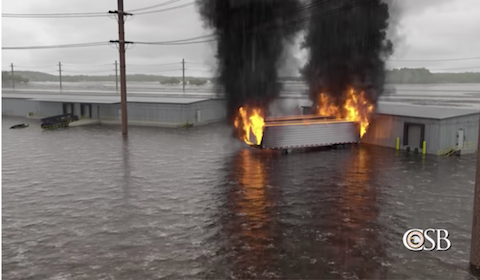
Animation still from the CSB’s safety video: Caught in the Storm: Extreme Weather Hazards on the details of what happened at the Arkema plant during Hurricane Harvey.
Source: CSB
The CSB’s Safety Alert outlines specific procedures to assure safe restarts following a severe weather event. For example, facilities are urged to follow established startup procedures and checklists, and to recognize that “human performance may be compromised due to crisis conditions.”
Additional safety protocols include checking bulk storage tanks for evidence of floating displacement or damage, and examining insulation systems, sewers, drains, furnace systems, electric motors and other equipment, including warning systems, to make sure they are fully functional.
CCPS’s document includes the following guidance:
- Assessment of and planning for natural disasters.
- First step in preparing for a natural hazard event is to identify the natural hazards that could occur (either meteorological or geological hazards).
- Create a site screening for natural hazards document format.
- Once hazards are identified, the next step is to gather data on the natural hazards. Data sources include Federal Emergency Management Agency flood maps, United States Geological Survey; National Oceanic and Atmospheric Administration; National Hurricane Center.
- Data may be used in evaluating facility design in relation to natural hazards, assessing risks, and emergency planning. This includes the probability of occurrence and the severity level.
In addition, as companies start up right after a weather incident, like a hurricane they should follow and trust and follow their established startup procedures and checklists and carefully perform pre-startup safety reviews. In addition, facilities should remember to:
1. Use appropriate management-of-change (MoC) processes before modifying any startup procedures, equipment, or staffing arrangements due to the impact of the hurricane
2. Make sure that adequate staffing and expertise are available before starting up, recognizing that human performance may be compromised due to crisis conditions
3. Use up-to-date startup procedures and ensure that the available staff are trained in how to execute them
4. Evacuate nonessential personnel (including personnel in trailers) until normal operating conditions are established