
That was the kind of domino effect responsible for the largest blackout in U.S. history in 2003, which left 55 million Americans and Canadians without power at an estimated cost of $6 billion. An even larger blackout in 2015 affected 57 million people in Italy. Blackouts cause ripple effects throughout the economies they affect, and they can be dangerous for people depending on electronics in hospitals.
By factoring the effects of demand side management into power grids using a model to simulate the rapid fluctuations involved, Pere Colet, a research professor at CSIC in Spain, and colleagues tested the system under different demand loads.
They were able to extend a model for the complex dynamics of blackouts in power grids to include three important factors: Intraday variability (peaks in electricity demand when people wake up or come home from work), power bursts caused by simultaneous switching on of many electric devices (either by chance or by large factories), and the effect of managing demand (using devices that delay switching on until the grid is more clear) on the power grid.

“With a growing fraction of electric energy generated from wind and solar power plants, which are subject to weather changes, fluctuations will increase, and we have to consider different control approaches to balance the system,” Colet said. “Devices that are smart enough to postpone certain tasks can help. This is what is known as demand side management.”
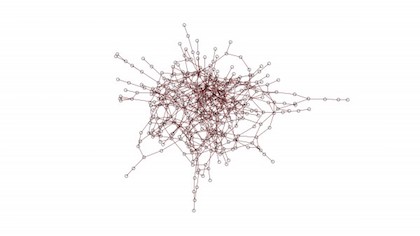
Image shows the nodes and lines of a prototypical power grid. It has a total of 400 nodes, of which 340 are nodes with only consumption, while the remaining 60 have consumption and generation. The nodes end up interconnected by 617 lines.Source: B. Carreras using Mathematica
The authors will further investigate more advanced forms of demand control, such as communication between nodes.
They are also exploring models that can assess the amount of solar and wind power that can be included in grids without increasing the risk of blackouts due to fluctuations.
“The implementation of demand side management techniques may be quite helpful in preventing blackouts,” Colet said. “One important aspect is that the customers will need to be trained to respond with social responsibility to the situations of the demand and learn to adapt to the situation. That will be particularly important when renewable energy sources are in use.”
Click here to view their paper.