
One way is to capture and measure gases emitted that contribute to the scent.
That is how the human nose works and that is why Nosang Vincent Myung, the Bernard Keating Crawford Professor of Engineering at the University of Notre Dame, is working to duplicate the human experience in a sensor-laden device.
The chemical properties of gases affect the electrical properties of the sensing materials, Myung said. By manipulating the size and shape of the nanoengineered materials, he and his team can make more precise sensors that function more efficiently and economically.

“An electronic nose can be used for a variety of applications,” Myung said. “For example, we can detect air pollutants or greenhouse gases. But we can also use it to uncover drugs and bombs, sniff out cancer and bacterial infections, as well as identify natural gas leaks and assess food quality.”
To get to this point, Myung earned a grant from the National Science Foundation’s Center for Bioanalytical Metrology for a Smart Process Analytical Technology System to monitor chemical/biochemical reactions in industrial and laboratory chemical processing applications in real time.
He and his team also are designing a smart agricultural sensor system to monitor the nitrogen cycle in fields to help eliminate greenhouses gases while attempting to enhance the potential yield of the produce being grown.
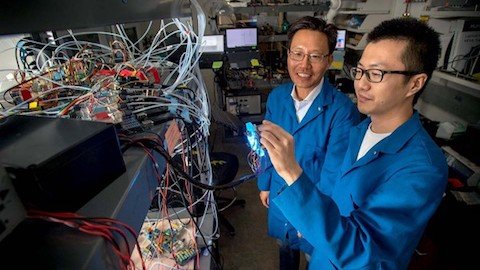
Nosang Vincent Myung (left) with Ph.D. student Bingxin Yang are developing an electronic nose that mimics a human.
Source: University of Notre Dame
In addition, they are developing a wearable smart sensor system for military personnel that can detect poisonous gases and other threats.
“Developing better sensors is critical for a number of industries,” Myung said. “The future will be shaped by our ability to design and build smart, accurate and low-powered sensors that will help us better understand and interact with the world around us.”