
Two pressure vessel explosions that occurred at the Midland Resource Recovery (MRR) facility in Philippi, West Virginia, killing three and severely injuring one other, have a probable cause of reactive, unstable chemicals exploding when workers tried to drain the uncharacterized, chemically treated liquid from natural gas odorizer equipment, federal investigators found.
In its final report, the Chemical Safety Board (CSB) said there is no way to know exactly what chemicals were present in the two odorizers before they were decommissioned and treated with sodium hypochlorite. But the CSB concluded that dangerous chemical reactions occurred within the two pieces of equipment that led to violent explosions when they were unsealed.
One possibility is the equipment contained methanol, which can react with sodium hypochlorite to form highly explosive methyl hypochlorite. The CSB’s final report said given the odorizers were filled with unknown liquid chemicals and sealed tight, along with the potential for dangerous reactive chemistry such as what occurs when sodium hypochlorite mixes with methanol, MRR’s equipment deodorizing process created the possibility that each treated odorizer was essentially a bomb.
In addition, the CSB investigation found MRR lacked an effective safety management system to identify and control hazards from reactive chemicals. Among other things, MRR had no formal hazard identification process in place to analyze or characterize what chemicals were inside the odorizer vessels — and in what quantity — before decommissioning and chemically treating the equipment with sodium hypochlorite. The company also lacked effective safeguards to prevent unexpected or uncontrolled chemical reactions.

In the first incident on May 24, 2017, two workers were fatally injured, and another was severely injured during the first incident. While the CSB was investigating that explosion, the MRR facility experienced a second explosion on June 20, 2017. The second explosion fatally injured a contractor employed to perform investigation and mitigation work at the facility following the original incident.
“MRR did not have, and federal regulations did not require, a comprehensive safety management system to identify and control hazards from reactive chemicals,” said CSB Interim Executive Authority Kristen Kulinowski..”As a result, two serious explosions occurred.”
MRR provides services related to natural gas odorants known as mercaptans, which are chemicals used to give natural gas a distinct unpleasant odor so the odorless gas can be detected by humans. One of the related services that MRR provides is to decommission and remove obsolete odorizer equipment from sites in the U.S. and Canada, and transport this equipment to its Philippi, West Virginia, or Midland, Texas, site for chemical treatment to remove the mercaptan odor from the steel before it is scrapped.
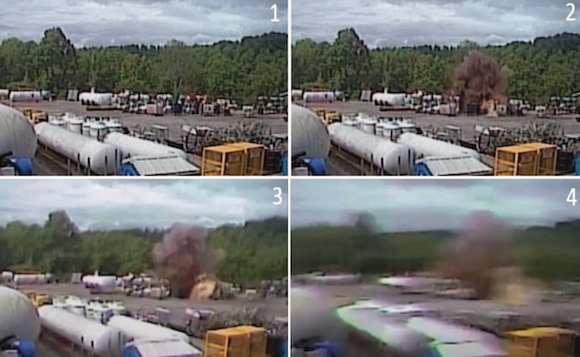
These still frames from an MRR surveillance camera capture the May 24, 2017, explosion.
Source: MRR
The chemical treatment to remove the odor involves filling the odorizing equipment with diluted sodium hypochlorite, or bleach, and sealing it shut for a period of time during which a liquid is formed that MRR referred to as “process water.” On May 24, 2017, two workers and the company owner attempted to unseal and drain the process water from one of the decommissioned odorizers when a violent explosion occurred, fatally injuring one of the workers and the company owner, and severely injuring the second worker.
Later, on June 20, 2017, a contract worker, who was hired to investigate and drain the remaining odorizers on site, was fatally injured when a second odorizer exploded shortly after it was unsealed.
In its report, the CSB provides the following key lessons for companies that deal with reactive chemistry:
• Companies need a robust safety management system in place to prevent reactive chemical incidents. If a process has the potential for uncontrolled chemical reactions to occur, the company should conduct a formal evaluation of the reactive chemistry, perform a hazard analysis, and ensure sufficient safeguards are in place to prevent reactive chemical incidents.
• Companies should have a thorough and complete understanding of their reactive chemistry under design conditions and under all foreseeable abnormal conditions. For example, companies should avoid treating uncharacterized waste materials with sodium hypochlorite because of the potential explosive hazards associated with its complex chemistry.
Since 2002, the CSB has called on the Occupational Safety and Health Administration (OSHA) and the Environmental Protection Agency (EPA) to expand their standards to cover reactive chemicals and hazards, but to date neither agency has acted on the recommendations.
“The CSB has long been concerned about the persisting gaps in federal safety regulations for reactive chemical hazards, and tragic incidents like the two explosions at MRR continue to occur,” Kulinowski said. “It is past time for OSHA and the EPA to adopt our recommendations to update their regulations to cover catastrophic reactive hazards that have the potential to seriously affect workers and the public.”
Click here to download the report.