
The goal is to make the testbed available to outside research teams and industry by 2025.
The major driver for the project at the University of California San Diego is the need to decarbonize the electrical grid, protect it from cybersecurity attacks and make it more resilient. To provide 50 percent – or more – of power from clean energy sources, power grids will have to be able to leverage distributed energy sources, and reliably manage dynamic changes, while minimizing impact on customer quality of service.
“We will be replicating the entire California power grid on one campus,” said Jan Kleissl, a professor in the Department of Mechanical and Aerospace Engineering at UC San Diego and the project’s principal investigator.
DERConnect Mission
The creation of the testbed, DERConnect, addresses an outstanding national need for large-scale testing capabilities across universities, national labs, industry, utility companies, and independent system operators to validate future technologies for autonomous energy grids in real-word scenarios. In fact, a major, current obstacle to the adoption of such technologies in the operations of real energy systems is the development of realistic test cases on a realistic scale.

Most utilities struggle with the fact renewable and distributed energy sources are not as stable as traditional sources, such as natural-gas power plants. Solar panel output depends on the weather, for example, as do wind turbines. At the other end of the grid, electric vehicles need charging for only a certain amount of time every day, and when not in use could end up used as temporary batteries to store energy from renewables.
As a result, while the number and diversity of distributed energy resources on the power grid is rapidly expanding, the adoption of these resources for power-grid balancing is hindered by concerns about safety, reliability and cost.
“This created the classic ‘chicken-and-egg’ situation, where the economics and impact of distributed energy resources cannot be demonstrated, because there are too few of them due to limited buy-in from independent system operators, and other practical concerns,” Kleissl said.
Solving Problems
Offering utilities, researchers, industry, and other entities a testbed with real-world communications challenges is essential to solve these problems and develop new distributed control theories, algorithms, and applications.
The envisioned testbed is built upon a number of technical innovations at UC San Diego that create a microgrid encompassing distributed energy resources, including energy storage, electrical vehicles and independent electrical and thermal systems in buildings. This distributed system is monitored and controlled by computing and networking systems that make it accessible to local and remote researchers as a programmable platform.
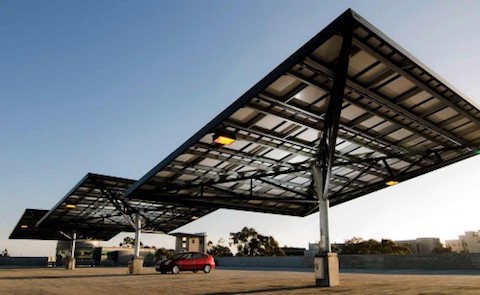
Solar trees on the top floor of the Gilman Parking structure at UC San Diego.Source: University of California San Diego
“The ultimate goal of any grid is reliability, and it is a top concern at UC San Diego, as we must constantly power medical centers and major research facilities,” said Gary Matthews, vice chancellor resource management and planning for UC San Diego. “The ability to interact with buildings and change their energy profile intelligently both enhances grid stability and saves a tremendous amount of energy. We support this living laboratory at the highest level, as this grant allows us to put infrastructure in place for future research, collaborating with leading scientists on real world solutions.”
DERConnect will include more than 2500 distributed energy resources, or DERs, on the campus’ microgrid, with its fuel cell and solar panels, a dozen classroom and office buildings, as well as 300 charging stations for electric vehicles. It will also entail the construction of a new energy storage testing facility on the East Campus.
An upgrade to the microgrid will give researchers real time control over heating, ventilation and air conditioning systems, lighting, solar panels, battery storage and EVs. The testbed’s control center will be housed in Robinson Hall on the UC San Diego campus, which will become a full controllable building that can disconnect from the campus’ grid at any time.
The bulk of the construction will take place this coming academic year. Researchers hope to be able to begin testing their equipment in 2022.
Integrated Platform
DERConnect will be the first integrated platform in the United States that matches the needed experimental evaluation and validation for the implementation of DER technologies, protocols, and standards.
A wide range of smart grid implementation use cases and testing procedures will end up established to provide controlled laboratory evaluations of DER control algorithms, emerging technologies, and protocols in areas such as distributed and renewable energy integration, energy storage systems, advanced distribution management, advanced metering infrastructure, and cybersecurity.
DERConnect will be able to explore which architectures and corresponding resource aggregation approaches allow consumers and grid operators to adapt their operations to achieve significant improvements in system-wide operational cost and renewables integration.
DERConnect will provide advanced controls, sensors, and data analytics to optimize building energy use, while maintaining and even improving comfort for occupants. For example, the Computer Science and Engineering building is instrumented with over 4,500 sensing and control points. Every control unit can end up controlled, from the position of air dampers to the speed of supply air fans to a room. DERConnect will upgrade 12 additional buildings with advanced control infrastructure that enables researchers to access operating conditions and set various operating parameters in real-time through novel programming methods and tools. This capability is particularly important as indoor operating conditions in buildings with central air handling become an important focus for researchers and building operators to reduce the spread of infectious diseases.
Researchers plan to conduct experiments to optimize learning conditions for students by changing airflow, temperature, humidity and lighting conditions in classrooms. Similarly, researchers could make changes in the energy prices at EV charging stations and see how this impacts customer willingness to delay charging to benefit the power grid.