
Phishing attacks’ lifespans continued to grow over the second half of last year, which placed more strain on resources, according to a new report.
This trend, revealed by Singapore-based Group-IB’s Computer Emergency Response Team (CERT-GIB), resulted in huge hike in the number of phishing websites blockages over the given period — it rose by over 230 percent year-on-year.
In 2019 in general, web phishers slightly changed their preferences: Email service providers gave way to cloud storages in the Top 3 of phishers’ targets, which comes as no surprise given the fact they keep record of literally every aspect of personal and sometimes corporate lives, holding gigabytes of sensitive data. Online services and financial organizations fill the other two spots in the top and seem to stay among the most frequent victims.
In the second half last year, as part of its work to detect and prevents threats distributing online, Group-IB CERT-GIB blocked 8,506 phishing web resources, while in the second half in 2018, the figure stood at 2,567.

This sharp upsurge in the number of blockages stems from the growing duration of phishing attacks: Attackers used to stop their fraudulent campaign as soon as their web pages were blocked, quickly mobilizing efforts for attacks on other brands. Today, they no longer dwell on it and continue replacing removed pages with new ones. One more trend that derives from that is the rising number of resources accumulated for a single attack.
The Top-3 of web phishers’ targets were online services (namely client software, online streaming services, e-commerce, delivery services and etc.) (29.3 percent), cloud storages (25.4 percent), and financial organizations (17.6 percent), researchers said.
It should be noted that some of the tech companies provide a wide range of Internet-related services and some of them, like cloud storages and email services, form separate categories. CERT-GIB’s findings indicate phishing attack perpetrators have revised their target pool. Thus, the number of phishing attacks on cloud storages nearly doubled last year, while Internet providers have seen the three-fold increase in the number of phishing scams targeting them. Both access to users’ cloud storages and accounts with Internet service provider enables the attackers to get much sensitive information like personal and payment data.
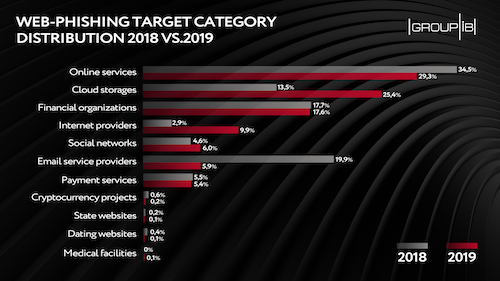
Distribution of web-phishing among target categories.
Source: Group-IB
This was accompanied by a lower interest to email service providers — the share of attacks on them decreased from 19.9 percent to 5.9 percent — and cryptocurrency projects, which became less attractive to cybercriminals as hype surrounding them started fading away.
In terms of where are the attacks coming from, the pedestal of web phishing-hosting countries, according to CERT-GIB’s, had its leader changed last year: The United States (27 percent), which was an irremovable leader in terms of hosting phishing for the past several years, yielded to Russia (34 percent), taking the second position, while Panama, well behind its two predecessors, remained third (8 percent) just as the year earlier.
Other countries hosting the majority of phishing pages in 2019 were Germany, South Africa, the United Kingdom, the Netherlands, Canada, Malaysia, and France.
Email remains the main method of delivering ransomware, spyware, backdoors and other malware, being used by attackers in 94 percent of cases. In the majority of cases — 98 percent — malicious items were delivered as attachments, while only 2 percent of phishing emails contained links, by clicking which a user could download malware. To compare, according to CERT-GIB, in H1 2019, 23 percent of phishing emails had a link in them, which might mean that malicious attachments proved to have a greater “ROI” for scammers.
In the second half of 2019, ransomware remained the most frequent “stuffing” of phishing emails, accounting for 47 percent of the total number of malicious attachments. Banking Trojans continued losing its popularity and represented only 9 percent of malicious attachments. They, in turn, let spyware and backdoors move ahead and become the second most popular malware with a 35-percent share. The reason behind it might be the expanding functionality of backdoors, which also enables them to steal financial data and replace instruments designed for harvesting banking data only, like banking Trojans.