
A perfect case in point was an Oct. 28 incident where an active drillship in the Gulf of Mexico (GOM) sustained major damage to various operational components while evacuating the rig from an area impacted by Hurricane Zeta, according to a safety alert from the Bureau of Safety and Environmental Enforcement (BSEE). Although no personnel casualties ended up reported, the incident presented a potential threat to rig personnel due to delaying the initiation of emergency evacuation procedures by remaining on location as a result of underestimating the severity of the storm.
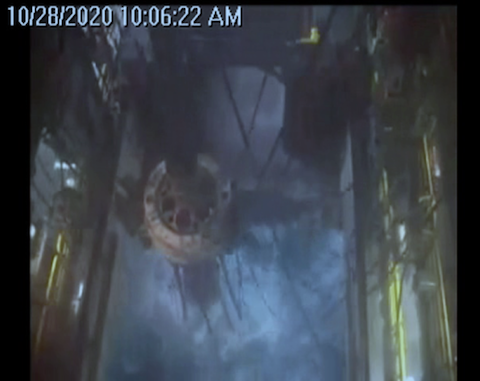
Riser in contact with the hull after the EDS.
Source: BSEE
On Thursday, Oct. 22, drillship personnel began monitoring weather disturbances, lower surface pressures and relatively higher amounts of moisture in the Caribbean, indicating potential organized storm development.

Tropical storm growth progressed in conjunction with T-Times (T-Times are the projected evergreen duration beginning with the identification of a storm and ending upon impact.), reducing over the course of six days as drilling and associated storm-prep operations continued. Throughout the six days, the drillship personnel were consistently advised by forecasters “the [rig] location is not expected to see direct, significant impacts.”
As the tropical storm began developing on Oct. 22, the well experienced a kick/influx of formation fluids during operations. After circulating out the kick, the rig pumped a cement squeeze on Oct. 24.
As the tropical storm transitioned into a hurricane Oct. 27, a packer was installed and tested as an additional barrier to further stabilize the well. The riser was displaced with seawater, and the work string, including the running tool, was pulled out of the hole in preparation for the hurricane.
As Hurricane Zeta’s arrival became imminent on Oct. 28, wind gusts were much higher than anticipated (roughly 100 miles per hour). Due to the hurricane’s intensity, the rig was pushed off location toward the Red Watch Circle, which is the maximum offset/inclination the riser string and its associated components are designed to withstand when latched to a subsea BOP. Due to the drillship’s increasing proximity to the Red Watch Circle boundary, the Emergency Disconnect Sequence (EDS) function activated, unlatching the Lower Marine Riser Package (LMRP) from the blowout preventer, allowing the rig to move off location.
After the EDS initiated, the riser contacted the hull in the moonpool due to the severe swells that formed throughout the storm, causing damage to the riser.
Furthermore, the LMRP endured damage to its frame, piping, and coflex after contacting the seafloor several times. A comprehensive property damage assessment was conducted by the operator and rig owner in the days following Hurricane Zeta. Inspectors determined the tensioner, flex joint, telescopic joint, LMRP, riser joints, cabling, and other riser-related components had sustained significant damage.
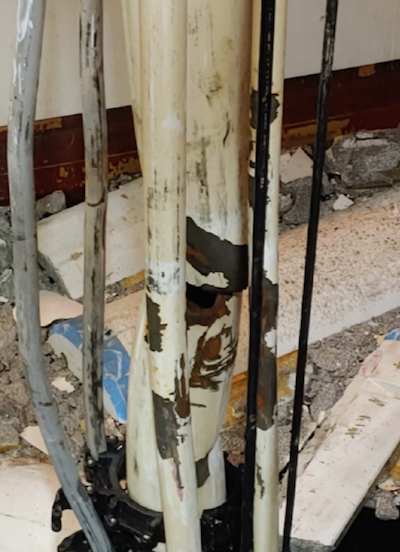
Ruptured riser joint.
Source: BSEE
As a result of that incident, BSEE recommends operators and contractors:
- Collectively review the Emergency Evacuation Plan (EEP), including estimated T-Times, periodically to ensure all information is accurate, up-to-date, and understood and agreed upon by the impacted workers.
- Consider enhancing procedures in the EEP for safely securing wells in anticipation of an approaching storm to include abnormal well conditions, such as ballooning or a kick/influx.
- Review bridging documents and consider the delegation of authority regarding emergency response and control to be a joint responsibility between the operator and rig owner. Initiation of this element should invoke a collaborative effort between both parties.
- Recognize and differentiate the roles and responsibilities between the Ultimate Work Authority (UWA) in the field and onshore management for determining the course of action when severe weather is approaching.
- Maintain constant communication between the shore base and offshore assets throughout the duration of adverse weather.
- Before the start of hurricane season, verify the criteria for initiating an EDS is accurate and consider all factors relevant to deteriorating weather conditions.
- Define phases and corresponding actions to be taken regarding emergency evacuation based on the status of forecast risk models and T-Times, such as updating Red Watch Circle parameters.
- Analyze and confirm design limitations of risers, tensioners, LMRP, and other critical well operations equipment.
- Evaluate the direction of disconnect for potential contacts to the LMRP and associated equipment with the seafloor.
- Notify BSEE when rig movements occur, clearly indicating if emergency action was implemented, as well as if any potential damage was encountered.
- Review this Safety Alert in conjunction with Safety Alert No. 363 – Injury Occurs when Non-evacuated Personnel Enter Weather-restricted Area as well as Safety Alert No. 401 – BSEE Identifies Improvements to Hurricane Preparedness During Risk Based Inspections to reinforce the proper protocols during inclement weather conditions.