
These incidents included overheating due to the effects of harmonic electrical currents, short-circuit faults, and moisture in the ASD cabinet, and all resulted in fire and arcing, according to a report from the Bureau of Safety and Environmental Enforcement (BSEE).
An ASD is a device used in electromechanical drives to control the speed and torque of an AC motor by adjusting the motor’s input frequency and voltage. ASDs control the speed of compressors and pumps to adjust the flow through pipelines.
- A short-circuit developing into a line-to-ground fault. The resulting thermal stress caused a fire and arc flash within the ASD.
- Overheating, which caused failure of electrical distribution equipment, cables, transformers, standby generators, etc., because of harmonic currents introduced by ASDs.
- Moisture ingress resulted in the loss of the ASD.
After discovering the issues and reviewing the causes, BSEE recommended operators and contractors consider the following:

- Establish and document monitoring procedures to identify potential problems associated with water ingress and overheating (e.g., periodic visual inspection and cleaning)
- Develop, document, implement, and maintain competency-based training systems, to include follow-up, so workers are continuously aware of the critical tasks involved with verification of the electrical installation and maintenance
- Ensure installation practices end up documented and meet fundamental electrical safety principles, including protection against overcurrent and earth fault current in accordance with API RP14F and 14FZ
- Ensure ASDs are installed in a protective environment, free from dust and other abrasive materials, corrosive gases and vapors, flammable gases and liquids, and high levels of atmospheric moisture
- Verify short circuit and thermal protection systems are installed and maintained according to OEM instructions (ground fault relays, fuses and circuit breakers) to protect power cable, motors and input rectifier bridge
- Ensure active or passive harmonic filters are installed to reduce or mitigate harmonics to tolerable levels as defined by IEEE-519, IEEE1531, API RP 14F and 14FZ, as determined by the power system documented analyses (i.e. harmonics analysis) or power quality monitoring
- Use K-rated or Harmonic Mitigating Transformer (HMT) dry-type transformers in applications where most of the load is non-linear (e.g. ASDs, LED lighting, computers, UPS, etc.)
- Ensure all ASD metallic parts, internal and chassis, end up bonded together and grounded to earth to confirm safe touch voltage potentials exist in ground-fault conditions
- Ensure the Safety and Environmental Management Systems (SEMS) tool is available to personnel and up to date, as required by 30 CFR 250.1900
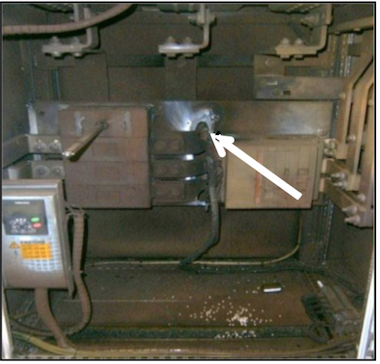
Short circuit fault in the ASD.
Source: BSEE
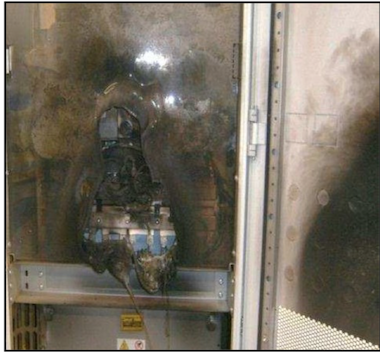
Arc damage to components.
Source: BSEE
In addition, all the recommendations should end up0 supported by documentation of policies and procedures and frequency checks.