
But those issues may end up alleviated as there is a new method in development that can convert natural gas into a non-explosive solid that can easily end up stored and transported, said engineers from the National University of Singapore (NUS). Using a novel, low-toxicity additive mixture they formulated, the conversion can end up completed in just 15 minutes.
The NUS team, led by Associate Professor Praveen Linga from the Department of Chemical and Biomolecular Engineering at the NUS Faculty of Engineering, worked on a process of converting natural gas into a solid form known as gas hydrates, or combustible ice, which consists of molecules of natural gas trapped in “cages” formed by water molecules.
The new additive mixture formulated by the NUS researchers contains L-tryptophan, well known as an essential amino acid in people’s diet. This muscle-building amino acid can also greatly speed up the caging of natural gas into solid hydrate. The NUS formulation produces the fastest reaction rate to date – more than twice as fast as existing standards, while being less toxic and safer to handle.

“Our breakthrough can really be put into perspective when you consider that it takes millions and millions of years for gas hydrates to form in nature, yet with our correct addition of secret ingredients to the system in small quantities, the same process can be effected in the laboratory in a matter of minutes,” said Research Fellow Dr. Gaurav Bhattacharjee, who worked on the project.
Moreover, the end-product is very stable and can be stored at -5 degree Celsius and atmospheric pressure, similar to the conditions of a home freezer. This is impressive considering the natural gas is reduced in volume by close to 90 times. Alternative ways to store natural gas include liquefying it at about -160 degree Celsius, or compressing it to almost 250 times atmospheric pressure. These approaches do not work at a large scale because either they are expensive or not so safe to store for long periods.
NUS researchers now want to convert larger volumes of gas into smaller volumes of solid at a pilot scale of 100 kilograms per day. If successful, this will enable the commercial adoption of the solidified natural gas technology and create a solid that is stable to store at atmospheric pressure. They hope to eventually scale it up for industrial use.
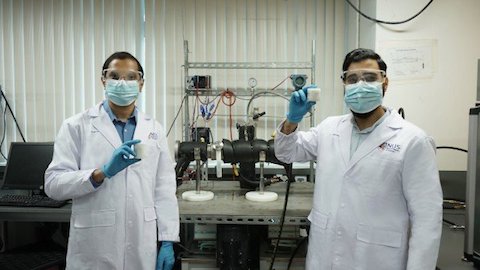
Associate professor Praveen Linga (left) and Dr Gaurav Bhattacharjee (right) from the National University of Singapore (NUS) hold solidified natural gas pellets. Behind them is a prototype of the machine they used in their patented conversion process.
Source: National University of Singapore
“This is especially relevant to natural gas importing countries like Singapore, where 95 per cent of electricity is generated using natural gas,” Linga said. “The development of such gas storage technologies would help enhance the country’s energy security.”