
The November 27, 2019, explosion at the facility’s South Unit which makes 1,3-butadiene and raffinate-1 resulted in injuries to two TPC employees and a security contractor and caused significant damage that still affects the facility today, according to a factual update issued Friday by the Chemical Safety Board (CSB). The incident also resulted in officials issuing a mandatory four-mile radius evacuation order which remained in effect until 10 a.m. two days later.
As a result of the incident, which ended costing $500 million, TPC decided to transition to a “terminal and services” operation while they evaluate and plan to rebuild. As part of this transition, multiple workers lost their jobs.
The South Unit produced 1,3-butadiene, primarily used to manufacture synthetic rubber and resins. Because 1,3-butadiene is a flammable liquid with a flashpoint below 100°F, and because the TPC PNO facility maintains an onsite quantity of 1,3-butadiene greater than 10,000 pounds, the production of 1,3-butadiene at the TPC PNO facility is regulated by the requirements of the Occupational Safety and Health Administration’s (OSHA) Process Safety Management (PSM) standard, 29 CFR 1910.119. Also, 1,3- butadiene is a regulated substance under section 112(r) of the Clean Air Act; as such, the process is subject to the Environmental Protection Agency’s (EPA) Risk Management Plan (RMP) Rule.
Blast Possibilities
In addition to its flammability, 1,3-butadiene is also highly reactive, with several undesirable reactions. In the presence of oxygen, butadiene readily reacts to form a butadiene peroxide. Butadiene peroxides, which are denser than 1,3-butadiene, will separate out and form a second liquid phase. If enough butadiene peroxides become concentrated, a critical mass can initiate a fire or explosion. Another potential undesirable reaction that can occur between oxygen and 1,3-butadiene is the formation of popcorn polymer. Popcorn polymer, if left uninhibited, grows exponentially. When popcorn polymer growth ends up unabated inside process equipment, the accumulated material can generate very high pressure inside the equipment and can ultimately lead to equipment rupture.

The incident started innocently enough during the night shift Tuesday, November 26, 2019. The unit was reportedly operating normally. However, at 12:54 a.m., a loss of containment event occurred, causing the liquid level in the final fractionator A to drop rapidly from its operating level.
The CSB calculated the liquid volume at the time of the initial level drop to be approximately 6,000 gallons. The liquid, which was primarily butadiene, emptied from the fractionator in less than a minute. The liquid vaporized upon release and formed a vapor cloud. Three workers were in the unit at that time. Two of them were facing toward the final fractionator A, and they both told the CSB after the incident they saw a pipe rupture. Of these two workers, one of them identified the release point to be in the suction piping of the final fractionator A to B transfer pump.
Suction Piping Failed
The third worker, who turned toward the sound of the release after the release occurred, also believed it was the suction piping into the final fractionator A to B transfer pump that failed. The workers’ observations are consistent with the unit’s recorded process data. The CSB has not yet visually confirmed the failure location due to the extensive damage and unstable structural conditions at the site.
Immediately following the loss of containment, the three workers departed the unit as soon as possible.
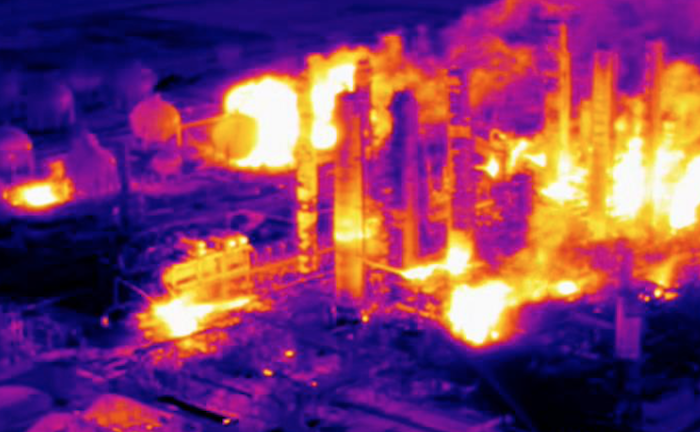
At 12:56 a.m., two minutes after the initial incident, the vapor cloud ignited, resulting in an explosion that created a pressure wave that heavily damaged the site and caused damage to buildings, including houses, offsite. Thermal imagery provided by TPC shows multiple fires following the explosion.
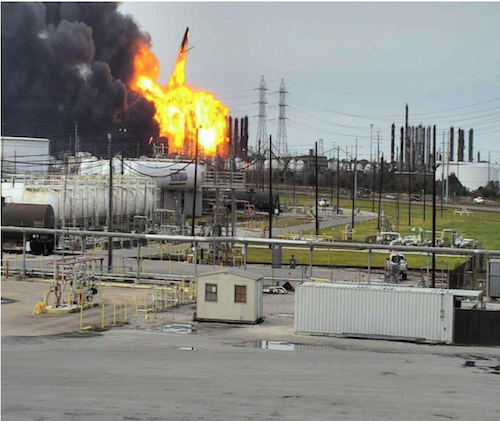
One of many explosions occurred at 1:48 p.m. on November 27, 2019, which propelled one of the South Unit towers across the facility.Source: Huntsman Corporation via CSB
At least two additional explosions occurred following the initial blast. At 2:40 a.m., a cell phone recording captured an additional explosion. That afternoon at 1:48 p.m., another explosion propelled one of the facility’s towers into the air. The tower landed within the confines of the TPC PNO facility. In addition to the propelled tower (later identified as an out-of-service debutanizer), four additional towers fell as a result of the blast and/or fires: The final fractionator A, an extractive distillation absorber, an out-of- service water wash tower, and the depentanizer.
Fires Contained in a Month
In addition, the explosion heavily damaged piping and equipment in the unit. Some of the resulting ruptured portions of piping could not end up isolated. Flammable process fluid continued to release from damaged equipment, and the fires burned for over a month. At 10:09 a.m. on January 4, 2020, the TPC Incident Command confirmed all fires were out.
At 6:08 p.m. Wednesday, December 4, 2019, the Port Neches Fire Chief issued a shelter-in-place order for the City of Port Neches “out of an abundance of caution.” At 10 p.m. that evening, the Jefferson County Judge issued a voluntary evacuation order for the City of Port Neches. At 12:29 p.m. Thursday, December 5, 2019, the Jefferson County Office of Emergency Management lifted the shelter-in-place and voluntary evacuation orders.
On top of the blast at the facility, Port Neches schools also ended up feeling the impact. Although Port Neches schools closed for Thanksgiving break November 27, 2019, schools did not reopen until December 3, 2019, because school officials needed additional time to clean debris, complete structural inspections, and repair school buildings. After returning to school for two days, the schools closed again, and they ultimately reopened December 9, 2019
Popcorn Polymer
As mentioned one of the other issues was the formation of popcorn polymers, which can form in process vessels containing a high concentration of butadiene. Popcorn polymer is a hard, porous, opaque material created when oxygen reacts with butadiene in various areas of a butadiene production plant. Popcorn polymer formation involves two phases: Initiation (seed formation) and propagation to polymer chains (seed growth). Oxygen reacts with butadiene to form peroxides; butadiene peroxides react with butadiene to form popcorn polymer.
That reaction can trigger high internal strain inside the popcorn polymer chains causeing them to rupture and form new polymer seeds, thereby increasing the total volume of popcorn polymer as the process repeats. This large increase in volume can produce enough pressure to swell or crack steel equipment. Throughout the industry, the buildup of popcorn polymer historically caused equipment ruptures leading to loss of containment.
Deadleg
A piping segment open to the process but does not have flow through it, for example due to a closed valve in the segment preventing flow, is known as a “deadleg.” Deadlegs can promote popcorn polymer formation.
From September 6, 2019 through the date of the incident (at least 82 days), the final fractionator A to B transfer pump was out of service. The suction piping into this pump was open to the process during this period but with no flow through it, and was therefore a “deadleg.” This is the piping segment workers in the unit observed rupturing.
Popcorn polymer was known to form in the South Unit before the incident. A TPC employee also noted the emergency pressure-relief valve on this bundle “was plugged solid with popcorn and polymer.”
On November 19, 2019, TPC installed temporary filters on the liquid outlet of the final fractionator B to “catch any popcorn polymer chunks before they reach the downstream piece of equipment.” On November 25, 2019, TPC collected a sample of polymer obtained from these temporary filters for analysis. The CSB and OSHA requested TPC perform an analysis to determine the characteristics and activity level of this butadiene polymer sample. The test characterization results indicated the polymer collected was butadiene-based popcorn polymer. Also, those portions of the tested sample all experienced limited growth (between 5 and 19 percent weight increase) over a six-day period.
Next Steps
CSB is continuing to conduct its investigation of this incident. Investigators are analyzing a wide range of aspects including:
- Equipment and system design
- Regulations, industry standards, and guidance
- Training, operations, and procedures
- Human and organizational factors
- Safety management system
- Historical and event data
At the conclusion of the investigation, the CSB will publish a final investigation report discussing the facts, conditions, and circumstances of the event; the causes or probable causes, and could issue safety recommendations to prevent the recurrence of similar incidents.
Click here for more details on the CSB factual update.