
No one ever wants a chemical safety incident to occur at their facility, but when one does, learning from the event can not only teach what went wrong, but also potentially save lives in the future.
That is the case when an Airgas nitrous oxide trailer truck exploded and killed a worker at its manufacturing facility in Cantonment, Florida, on August 28, 2016.
While difficult, Airgas, an Air Liquide company, through U.S. Chemical Safety Board (CSB) recommendations, is driving chemical safety change through its rapid and comprehensive actions in developing and implementing company-wide process safety management components for its nitrous oxide operations.
On that August 28 day, the nitrous oxide trailer truck explosion fatally injured the only Airgas employee and heavily damaged the facility. The CSB determined the most probable cause of the incident was during the initial loading of a trailer truck, a pump heated nitrous oxide above its safe operating limits. This likely started a nitrous oxide decomposition reaction that propagated from the pump into the trailer truck, causing the explosion.

CSB’s investigation found Airgas did not have an effective safety management system that identifies, evaluates, and controls process safety-related hazards like those that led to the explosion.
Following the incident, the company quickly began a comprehensive initiative to review the safety programs for its nitrous oxide production facilities, trucking fleet, and cylinder-filling operations. The scope of this safety initiative included 17 different areas for process safety improvements (e.g. inherently safer design, hazard analysis, and management of change (MoC).
As a result of the investigation and in recognition of the proactive work Airgas initiated prior to the completion of our investigation, the CSB issued a single recommendation to the company to complete its “in-progress” post-incident actions and to continue safety initiatives for its nitrous oxide operations.
Airgas embraced the challenge and aggressively pursued actions to close out the CSB recommendation. These actions resulted in an approach that now exceeds the quality of a number of similar company safety programs where such operations end up covered by the Occupational Safety and Health Administration (OSHA) Process Safety Management (PSM) standard.
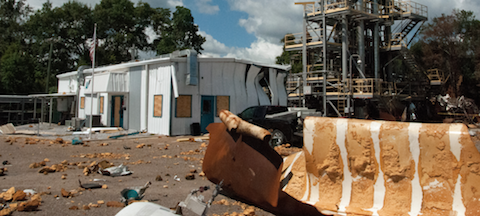
Post-incident photo of the administrative and operations building at the Airgas nitrous oxide manufacturing facility in Cantonment, Florida nitrous oxide manufacturing facility.
Source: CSB
Airgas developed and implemented recommended PSM components for its nitrous oxide business by creating a new Industrial Risk Management Program, a process hazard analysis methodology, a MoC procedure, and a project design authority within the company, and by initiating a project risk identification process. These are all now included in written programs added to the company’s safety manual and incorporated into company operations.
Some of the company’s most significant actions focused on initiatives associated with the most effective and preventive efforts found in:
- Hierarchy of controls
- Inherently safer design
- Engineering solutions
- Hazard evaluation
- Improved audit practices
Airgas also strengthened its facility operations by implementing the following improvements:
1. Adding technical and hourly staffing
2. Applying more appropriate transfer pumps for nitrous oxide service
3. Upgrading maintenance requirements for flame arrestors (this followed a significant technical review of existing flame arrestor technology)
4. Updating procedures and training for drivers and operators during transfer operations
5. Issuing personal gas monitors to personnel to help eliminate or mitigate potential exposure to nitrous oxide
In a little more than two and a half years, Airgas re-engineered its entire approach to managing process safety in its nitrous oxide business. Airgas also increased its efforts aimed at sharing lessons learned and good safety practices, inside the company and with the broader compressed gas industry. In addition, Airgas implemented new information-sharing practices internally, which connected to ongoing engineering assessments, audits, and training for operations personnel.
Nothing will bring back what happened that day, but with this new approach, and staying on top of its process safety program, incidents like the one that occurred four years ago should never happen again.