
The fire, which burned down the Washington Potato Company potato dehydration plant, forced the immediate evacuation of one third of the town of Warden (pop: 2700) for several hours due to concerns that an ammonia tank located in the building could burst.
The fire broke out at the Washington Potato Plant at 5:30 p.m. in one of the dehydrators, said Kyle Foreman with the Grant County Sheriff’s Office. Frank Tiegs, a large grower who also owns processing plants in Oregon and Idaho, owns the facility.
The fire triggered an urgent immediate evacuation at 8:30 p.m. for a significant part of the town Warden, due to concerns a 5,500-gallon tank of ammonia in the building might explode. In the affected parts of Warden, all areas West of Road U-SE and South of SR170, law enforcement officers went door-to-door to notify persons to leave without delay.

Firefighters requested help from all fire departments in Grant County to help contain the flames. By 8 p.m., more than two dozen firefighting crews were at the blaze, Foreman said.
The fears of explosion subsided early Friday morning and Warden residents were able to return to their homes at 1 a.m.
Friday morning the Grant County Sheriffs office posted on Twitter the fire was under control.
The central Washington facility was one of two such potato processing plants in Washington state.
There were no injuries in the fire.
Cause of the fire remains under investigation.
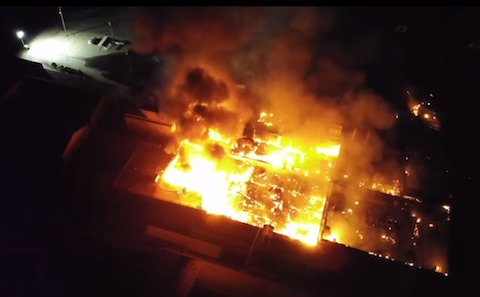
Drone photo shows how the fire devastated the Washington Potato Company Dehydration facility in Warden, WA.
Source: Grant County Sheriffs office
In 2019, Potatoes USA reported that 8 percent of the U.S. potato crop was processed for dehydrated flakes, compared with 41 percent of the crop used for frozen potatoes, 21 percent for potato chips, 25 percent for fresh market sales, 4% for refrigerated potatoes and 1 percent for other uses.
Potatoes that don’t make the quality or size grade for fresh or frozen markets often end up sold to dehydrated processors.
Mark Klompien, chief executive of United Potato Growers of America, said that he has heard Tiegs plans to rebuild the facility and have that facility at least partially operational within a year.
“As for the fresh market, wouldn’t expect any huge impacts as most of the potatoes that would have been destined for that plant wouldn’t be suitable for the fresh industry,” Klompien said, though he said the fire could have a slight effect on the overall potato volume available in the Northwest.