
BCIs have been used in a broad range of applications, including neuroscience, psychology, clinical rehabilitation, and entertainment. As one of the most commonly used BCI systems, electroencephalogram (EEG)-based BCI speller, which allows the user to input text to a computer using EEG signals, is particularly useful to severely disabled individuals, e.g., amyotrophic lateral sclerosis patients, who have no other effective means of communication with another person or a computer.
However, one very important question: Are these BCI spellers secure?
“It shows for the first time that one can generate tiny adversarial EEG perturbation templates for target attacks for both P300 and SSVEP spellers, i.e., mislead the classification to any character the attacker wants, regardless of what the user intended character is. The consequence could range from merely user frustration to severe misdiagnosis in clinical applications,” the research team said in their article entitled “Tiny noise, big mistakes: adversarial perturbations induce errors in Brain-Computer Interface spellers.”

“More seriously, these perturbation templates are so tiny that one can barely distinguish the adversarial EEG trial from the original EEG trial. When drawn together, the signals look almost completely overlapping,” they said. “The adversarial perturbation templates can even stay imperceptible to some widely-used approaches for evaluating the quality of EEG signals.”
“These spellers’ ability to defend adversarial perturbation templates is totally different from their robustness to random noise,” the researchers said. “Even the BCI spellers which show excellent performance against random noise can be manipulated by these deliberately-designed perturbation templates with a high successful rate.”
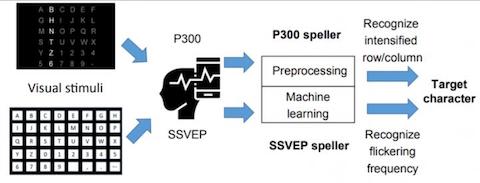
For each speller, the user watches the stimulation interface, focusing on the character he/she wants to input, and EEG signals are recorded and analyzed by the speller. The P300 speller first identifies the row and the column that elicit the largest P300, and then outputs the character at their intersection. The SSVEP speller identifies the output character directly by matching the user’s EEG oscillation frequency with the flickering frequency of each candidate character.
Source: Science China Press
They also said this security concern is not only specific to the victim models used in these EEG-based spellers, but also other popular BCI systems.
“It should be noted that the goal of this study is not to damage EEG-based BCIs,” Professor Wu said. “Instead, we aim to demonstrate that serious adversarial attacks to EEG-based BCIs are possible, and hence expose a critical security concern, which has received little attention before. Our further research will focus on addressing this security issue and making BCI systems safer.”