
The survey of 1,200 U.S. employees, conducted by the online training platform TalentLMS and the vulnerability management company Kenna Security, found employees are most knowledgeable in laptop security, while they are unaware of how to secure sensitive data and recognize harmful files.
The report shed light on the effectiveness of cybersecurity training, and examines employees’ awareness, habits, and knowledge related to staying safe in cyberspace.
- 59 percent of employees were trained on cybersecurity as a response to the work-from-home shift caused by COVID-19
- Having a cybersecurity training program in place isn’t enough to ensure cyber safety: 61 percent of employees who have received cybersecurity training failed a basic test
- Surprisingly, the highest fail rates were reported in the following two industries: Information services and data (83 percent of employees failed) and Software (73 percent of employees failed)
- 74 percent of respondents who answered all seven test questions incorrectly said they feel safe from cybersecurity threats
- 33 percent of employees store their passwords in their browsers, even though that puts network security at risk
- Remote employees collectively feel less safe from threats (63 percent), than office employees (51 percent)
While the survey results show training has a positive impact on some aspects of employees’ cybersecurity habits, such as protecting their computers and correct password management, these effects are not consistent across all areas. This brings to light some of the “blind spots” of cybersecurity training programs, which, if left unaddressed, create vulnerabilities that expose employees and their companies to cyber risks and attacks.

“Simply offering a cybersecurity training program does not guarantee a skilled or educated staff,” said Victor Kritakis, chief information security officer at TalentLMS. “Such programs are usually theoretical, full of technical terms, and, well, boring. Cybersecurity training should be fun, hands-on, and use real-life examples. And this is because staying safe and protected in cyberspace is a hands-on, practical skill.
When asked what would make cybersecurity training more engaging, 52 percent of employees said they would like it to be presented in a simpler and less technical way, while 50 percent would like it to be more fun and gamified.
“This survey revealed an interesting paradox — that office employees feel safer from cybersecurity threats than remote ones, and yet, they have much worse security habits,” Kritakis said. “These bad habits have to do with password management, laptop encryption, and the use of personal devices. Ensuring employees have good habits in these areas should be part of a company’s basic security policies and procedures.
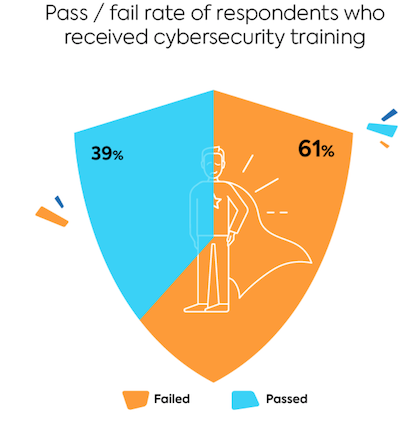
Source: TalentLMS
“Companies tend to be less concerned about the habits of their office employees, than those of their remote employees,” Kritakis said. “But the reality is that employers should not neglect security just because their staff is in an office environment. The quiz results showed that office workers have many blind spots when it comes to cyber safety, perhaps even more than remote workers.”
Click here for the full report.