
A silicone manufacturing process generated a flammable gas inside an enclosed production building at the AB Specialty Silicones facility in Waukegan, Illinois, and when the vapor cloud found an ignition source, it ignited and left four workers dead and one injured.
As a result of the May 3 disaster, the U.S. Chemical Safety Board (CSB) started an investigation into the incident and Wednesday they released a factual update and timeline. The CSB’s investigation is ongoing.
“The CSB’s ongoing investigation will establish how a similar incident can be prevented,” said CSB Interim Executive Dr. Kristen Kulinowski. “To date, the agency has determined important details about this tragic explosion that destroyed the facility and took the lives of four workers. Ultimately, we will find the root cause and issue safety recommendations to prevent a similar incident.”
The following are CSB’s updated facts into the investigation:
• At the time of the incident, the facility was manufacturing a product referred to as EM 652. EM 652 is AB Specialty Silicone’s trade name for a silicon hydride emulsion used as a water repellent. Under certain conditions, EM 652 and one of the raw materials used to make EM 652, a compound called XL10, have the capability to produce hydrogen gas. Under certain conditions, hydrogen gas is flammable.
• On May 3, AB Specialty Silicones operators were making back-to-back batches of EM 652. AB Specialty Silicones had started the first batch earlier in the week. During the second shift on May 3, the first batch was packaged into storage containers and an operator began production of the second batch.
• Around 9:30 p.m., a few minutes before the incident, the operator making EM 652 began yelling, apparently concerned and frustrated by a problem developing in the EM 652 process.
• This unusual activity captured the attention of a second operator and the shift supervisor, who ran over to where the EM 652 was being produced. By the time the second operator and the shift supervisor made it to the emulsions area a tank making EM 652 was overflowing with foam. There, the operator told them he had just added the first two raw materials of the process into the tank, including XL 10.
• While the operators and the shift supervisor were talking, the tank made a “very strange sound” and “erupted.” Witnesses described a hot and smoky scene as material overflowed from the tank and spilled onto the floor.
• The shift supervisor directed workers to take actions to ventilate the hazy vapor from the building by turning on exhaust fans and opening the garage doors. But before an operator was able to turn on the fans, the building exploded, fatally injuring four people. The force from the explosion was felt up to 20 miles away in neighboring communities and damaged surrounding businesses.
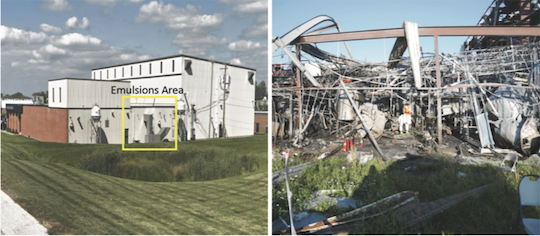
AB Specialty Silicones emulsions area before and after the blast. On the left, photo of location of the emulsions area prior to the incident. On the right, photo of the emulsions area post‐incident.
Source: Google Maps, left; CSB, right

The investigation team has also documented the scene, finding a number of details which are key to the ongoing analysis:
• The instructions to make EM 652 warn of the dangers of the production of hydrogen gas when XL 10 is in contact with acids or bases.
• The EM 652 was made in a set of two atmospheric tanks loosely sealed. Workers would open the top of these tanks during the production process to, among other things, perform visual observations. These tanks had no engineered system to direct flammable gas, including hydrogen, to a safe location.
• The building ventilation system likely caused the flammable gas cloud to mix with air and disperse throughout the building.
• There were no flammable gas detectors or hydrogen gas detectors with alarms to warn workers of the significant hazard. The generation of gas in the emulsions tank could produce foaming; however, foaming does not normally occur during this portion of the EM 652 process. The placement of the main air mover near the EM 652 process further increased the potential explosion danger from flammable gases generated in the emulsions area.
Click here for more information.