
Before removing the heater tube, a job safety analysis (JSA) was performed to ensure crew members understood the sequence of planned steps and associated hazards involved in the task, according to a report with the Bureau of Safety and Environmental Enforcement (BSEE).
After work began, the crew determined removing a handrail was necessary to create enough space to access the heater tube successfully.
Crew members were aware that removing the handrail was not part of the original job scope, but began removing the handrail anyway without revising the JSA or conducting a toolbox discussion of the additional work requirements and potential hazards.
To free the last leg of the handrail from its socket, a crane equipped with a nylon sling attachment was used to apply upward tension while the crew used a 5-foot prybar leveraged underneath the kickplate. When the handrail suddenly broke free, the force of tension caused it to strike a crew member, knocking him to the ground and fracturing his nose and orbital socket.

The crew member ended up transported to shore for medical evaluation, where doctors determined they had to perform surgery.
The company’s incident investigation process determined the causal factors of this incident to be:
- Inadequate work planning: The job steps did not cover the entire process to successfully remove the heater tube from the heat exchanger. The JSA should have been revised to include the job steps from the additional work that was added, including control measures to safely identify and mitigate all hazards involved with the task of removing the handrail.
- Inadequate training: Three of the five crew members were found to be deficient in their formal “company-specific” JSA training.
- Noncompliance with company policies: None of the employees involved followed company policy to stop the job when the crew deviated from the tasks identified in the original JSA.
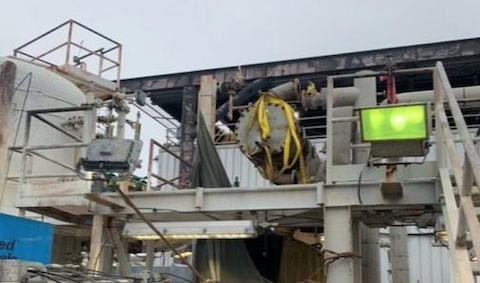
Location where handrail injury occurred.Source: BSEE
Along those lines, the BSEE recommends operators consider the following:
- Assess, develop, and implement Leadership/Supervisory training and evaluation programs with periodic refresher training to ensure commitment and understanding of company SEMS policies and expectations.
- Assess, develop, and implement in-house JSA and Stop Work Authority training and evaluation programs with periodic refresher training specific to company SEMS policies and expectations.
- Ensure personnel discuss additional duties and hazards that come up with a change in work assignment. Use stop work authority if hazards are not identified, or equipment is not adequate for the job.