
While witnessing a field operator perform a downhole safety valve test, the BSEE inspector proceeded to access the well bay deck to document the shut-in tubing pressure on a well. When he stepped onto the grating of the well access platform, the grating below him gave way, resulting in the inspector falling to knee-level before catching himself on nearby equipment.
The inspector was able to raise himself to safety and sustained minor abrasions.
- Pre-punched galvanized angle with bolted and/or clipped connectors were used for the construction of the permanent deck and support columns, which is not typical and not recommended.
- Due to vibration and movement, some of the connecting bolts became loose and some had completely backed out of the connections leaving framing members loose and/or unconnected.
Additionally, based on the review of the assessment, BSEE concluded the structural engineering analysis was ineffective due to the following factors:

- No lateral loads were applied in the analysis. Due to the size and location of this deck, coupled with the field observations of damage caused by “vibration and movement,” the analysis should have included wind loading in accordance with API RP 2A-WSD.
- A 50 pounds per square foot (psf) live load was applied across the entire elevated area in the analysis. The typical design load for walkways and areas intended for personnel access is 100 psf.
Furthermore, deficiencies like the items previously listed were identified on the 2019 Level I Survey and were not addressed.
Therefore, BSEE recommends operators and contractors consider the following:
- Verify proper construction materials and design parameters are utilized when fabricating and installing access platforms, walkways, ladders, handrails, etc.
- Install barricades to prevent personnel from entering an unsafe area if deficiencies are identified.
- Remove all wellhead access platforms erected with pre-punched galvanized angle iron from the platform in lieu of attempting salvage repairs.
- Ensure all wellhead access platforms as well as any structural decks constructed for offshore platforms are designed by licensed civil or structural engineers and meet the following OSHA and API standards for safety:
— 29 CFR 1910.29(f)(7)
— 29 CFR 1910.29(g)(1)
— 29 CFR 1910.29(f)(3)
— API RP 2A-WSD
— 29 CFR 1910 Subpart D – Walking-Working Surfaces - Review this Safety Alert in conjunction with Safety Alert No. 413: Hazards Identified in Level I Surveys not Communicated to Affected Personnel.
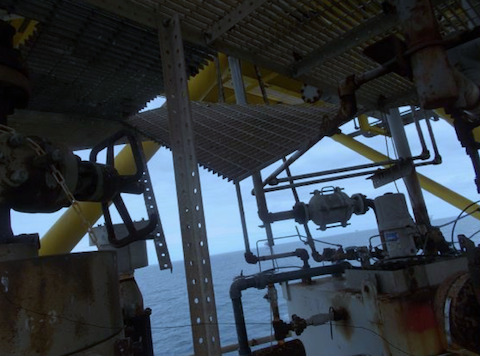
View from below the well bay deck of the loose grating an inspector slipped through.
Source: BSEE