
Protecting mobile devices from cyber-attacks and accelerating the adoption of secure mobility for the federal government is critical.
To address this issue for front-line users — federal law enforcement for one — the government is leveraging commercial capabilities to address its needs. And that is a research focus of the Department of Homeland Security (DHS) Science and Technology Directorate (S&T).
“With new state-of-the-art capabilities continually being realized in the commercial industry, S&T is working diligently to partner with industry to further strengthen the mobile ecosystem and protect the federal government’s workforce,” said Vincent Sritapan, S&T Mobile Security Research and Development Program Manager.
Vulnerabilities found in mobile devices and apps can end up exploited by attackers to access and control a device and its sensitive information. Compounding this issue, savvy attackers can craft threats that go undetected. They do this by gaining access deeper down the mobile device stack, including disabling existing defenses in the high-level operating systems and applications.

This vulnerability puts operational data at risk and leaves mobile device users unsure of the security of their equipment. Stopping these attacks and ensuring a device is not compromised are major challenges for chief information security officers in the federal government and in the private sector.
To combat these security issues, S&T partners Qualcomm Technologies, Inc. (Qualcomm Technologies) and Kryptowire LLC demonstrated a set of application programming interfaces (APIs), together called the Mission Critical Grade Security Layer (MCGSL).
“The MCGSL could help strengthen the mobile ecosystem and the information and communications technology supply chain for user equipment such as smartphones,” said Sritapan. “It significantly raises the bar by checking application behavior and providing continuous protection against cyber-attacks targeting mobile devices.”
The APIs enable increased visibility to mobile application platforms to monitor and validate activity of third-party apps, device run-time integrity checking and continuous user authentication through multiple biometric, behavioral and contextual factors.
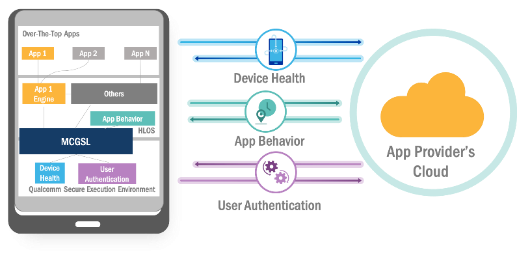
MCGSL demonstrates hardware-anchored access to APIs for device health, app behavior and user authentication.
The MCGSL operates at the hardware level, making it much harder for hackers to break into a mobile device without detection. By continuously checking device health, application behavior and user authentication, MCGSL provides users with peace of mind that their data and programs are secure.
“MCGSL is a valuable tool that could help mobile security teams root out vulnerabilities in mobile devices before they can compromise sensitive government information,” said Larry Henschel, senior advisor at DHS’s Cybersecurity and Infrastructure Security Agency, which had a keen interest in this project since the MCGSL can end up leveraged to help secure information and communications technology.
To prove their approach, Qualcomm Technologies partnered with mobile security provider, Kryptowire, which demonstrated how developers and ecosystem partners can leverage the MCGSL to improve their existing security models for detecting mobile threats. This demo served as a lighthouse example for other application platforms to address the critical need for greater trust in mobile devices.
Qualcomm Technologies’ commercial capabilities and Kryptowire’s military-grade mobile application security platform proved a successful model.
The demonstration of the MCGSL tool has been completed.
This tool was developed as part of the Mobile Security Research and Development Program.