
The employee, who was wearing protective gear at the time of the incident, was checked for contamination, then returned to work, company and federal officials said. The plant, undergoing decommissioning, ended up cited by federal regulators for a low-level safety violation.
While moving spent fuel out of the plant’s cooling pool and into concrete and steel casks for storage, a test of a lid seal resulted in a spill through the cask’s vent, said Neil Sheehan, a spokesman for the Nuclear Regulatory Commission (NRC).
The contaminated water splashed onto a worker and spread to two levels of the reactor building, Sheehan said. The employee’s clothes became contaminated and the worker received a radiation dose of less than 10 mrem, or millirem.

“To put that dose in perspective, the annual occupational dose limit for nuclear power plant workers is 5,000 millirems, or 5 rems,” Sheehan said.
The average American receives roughly 0.62 rem (620 millirem) in a year, half of which is from natural, background radiation in the environment, according to the Nuclear Regulatory Commission. A chest x-ray is about 10 millirem, according to the agency.
The employee was wearing the required personal protective equipment, including coveralls, at the time of the splash, said Holtec spokesman Joseph Delmar.
Holtec is decommissioning the defunct Oyster Creek nuclear power plant, as well as Pilgrim Nuclear Power Station in Massachusetts and Indian Point Energy Center in New York.
“Holtec holds the safety of all associates to be the highest priority,” Delmar said.
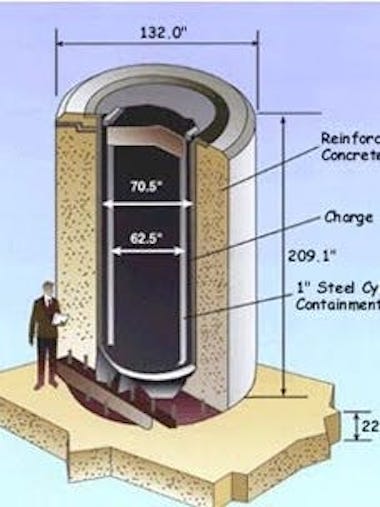
Radioactive waste generated by the Oyster Creek power plants is stored in vertical dry casks, where the spent fuel rods are encased in concrete.
Source: Nuclear Regulatory Commission
The employee changed clothes, was checked for contamination and returned to work after the spill, Delmar said.
“In response to this event, Holtec stopped additional spent fuel loadings for several days as it examined the equipment and procedures,” he said. “A modification was made to the valve design, loading procedures were revised, and additional training of the cask loading team was conducted. The fuel loading campaign safely resumed and was completed in late May without any further incident.”