
Following the incident, the crew was unable to replicate the failure. As a result, a technician replaced the parking brake actuator valve and successfully tested the brake to verify validity of the repair, according to a report from the Bureau of Safety and Environmental Enforcement (BSEE). The crew then proceeded with well work operations.
Drawworks is used to hoist or lower several hundred thousand pounds of weight and comes in AC, DC or mechanical power units. A modern drawworks consists of five main parts: The drum, the power source, the reduction gear, the brake, and the auxiliary brake.
After applying a minimum amount of torque, the parking brake failed again. This failure caused the traveling block to descend 5 feet and damage a stand of drill pipe. The driller quickly reengaged the brake handle stopping the traveling block.

Following the incident, the rig maintenance crew disassembled, inspected, and replaced components within the brake hydraulic power unit. Among the replaced components was a solenoid valve which had minor damage to the spool.
Upon completion of the repairs, the crew tested the system multiple times, completed a commissioning checklist, and received successful test results. The original equipment manufacturer’s engineering department assessed the corrective actions taken. The manufacturer expressed confidence the system had been returned to the original designed intent and was safe for use.
Three days later, the drawworks parking brake failed to engage for the third time.
This time, the driller noticed the “Emergency Caliper Pressure” gauge did not drop to zero pressure indicating the parking brake failed to engage. The operation was immediately stopped before damage could occur. The maintenance team inspected the brake circuit and discovered air leaking into the pilot line.
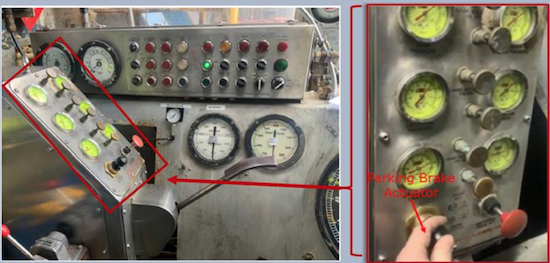
Drawworks parking brake control panel including parking brake actuator knob.
Source: BSEE
The team was able to simulate the brake failure. The brake would not function as designed with a pilot pressure range of 32-40 psi, when the pilot line should have been zero pressure.
The maintenance crew on the platform found the following issues:
- Cut O-ring on a shuttle valve
- Internal leaking on the emergency stop piloted valve
- Leaking crown-o-matic toggle valve.
After replacing the faulty components, the team successfully functioned the brakes 93 times and then successfully performed and documented brake endurance testing.
BSEE recommends operators consider:
- Confirming drawworks parking brake engagement by observing desired/required pressure on the hydraulic pressure gauge prior to releasing the drawworks service brake handle.
- Installing additional parking brake indicators, such as a visual light indicating the brake engagement and/ or an audio alarm indicating failure of the parking brake engagement.
- Establishing testing and appropriate change-out frequencies for critical circuit components and not operating critical circuit components to failure.
- Maintaining proper preventative maintenance on critical pneumatic components to ensure the rig air supply system is dry and free of contaminants and particulate matter. Contaminated and/ or wet air supply is known to cause failure on sealing surfaces inside pneumatically controlled or operated equipment.