
Then, when a researcher sends a Bluetooth command, the sensor — about one tenth the weight of a jellybean, or less than one hundredth of an ounce — releases from its perch and can fall up to 72 feet and land without breaking. Once on the ground, the sensor can collect data, such as temperature or humidity, for almost three years.
“We have seen examples of how the military drops food and essential supplies from helicopters in disaster zones. We were inspired by this and asked the question: Can we use a similar method to map out conditions in regions that are too small or too dangerous for a person to go to?” said Shyam Gollakota, a University of Washington associate professor in the Paul G. Allen School of Computer Science & Engineering and senior author of a paper on the subject.
While industrial-sized drones use grippers to carry their payloads, the sensor is held on the drone or insect using a magnetic pin surrounded by a thin coil of wire. To release the sensor, a researcher on the ground sends a wireless command that creates a current through the coil to generate a magnetic field. The magnetic field makes the magnetic pin pop out of place and sends the sensor on its way.

Researches designed the sensor with its battery, the heaviest part, in one corner. As the sensor falls, it begins rotating around the corner with the battery, generating additional drag force and slowing its descent. That, combined with the sensor’s low weight, keeps its maximum fall speed at around 11 miles per hour, allowing the sensor to hit the ground safely.
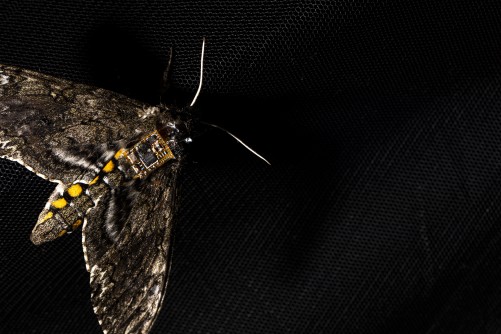
A 98 milligram sensor system can ride on the back of a moth which can then drop to the ground and start collecting data. Shown here is a Manduca sexta moth with the sensor on its back.
Source: Mark Stone/University of Washington
Researchers envision using this system to create a sensor network within a study area. For example, researchers could use drones or insects to scatter sensors across a forest or farm they want to monitor.
Once a mechanism is developed to recover sensors after their batteries have died, the team expects their system could end up used in a wide variety of locations, including environmentally sensitive areas. The researchers plan to replace the battery with a solar cell and automate sensor deployment in industrial settings.